
Key takeaways
- A niche edit joins an aged, indexed article; a guest post is a new article written for your topic.
- Guest posts give more control over angle and anchor placement.
- Niche edits often work faster on page two pushes because the page is already trusted.
- Four quick questions about topic, timeline, anchors and profile gaps usually settle the choice.
- Most strong campaigns blend both types rather than picking just one.
The short answer on niche edits vs guest posts: a niche edit adds your link to an article that already exists, while a guest post is a brand new article written around your topic and published with your link inside. Both put a contextual link on a real site. They differ in age, control and how fast they tend to work.
Niche edits borrow the strength of an aged page. Guest posts give you control over the whole piece of content, from the angle to the anchor placement. If your page needs topical depth and a story built around it, a handwritten guest post is usually the better fit.
Most campaigns do best with both. Below we break down how they compare and give you a simple way to decide which one to order first.
Niche edits vs guest posts at a glance
Here is the side by side view we give clients who ask this question on support chat.
| Factor | Niche edit | Guest post |
|---|---|---|
| Page age | Aged, already indexed | New page, indexed after publishing |
| Content | A short addition to existing copy | A full new handwritten article |
| Topic control | Limited to the existing article | Written to match your page closely |
| Anchor flexibility | Must fit the existing paragraph | Can be placed exactly where it reads best |
| Typical speed of effect | Often quicker, page is already trusted | Builds as the new page gets crawled and linked |
| Site standards (our packages) | Moz DA 20+, RD 100+, traffic 1,000+ | Moz DA 20+, RD 100+, traffic 1,000+ |
| Delivery | 7 to 30 days | 7 to 30 days |
The site standards are the same on purpose. With us, the choice between the two is about the shape of the link, not about getting a weaker site.
Where guest posts win
A guest post is a full article, often 800 words or more, built around a subject close to your page. That gives search engines a lot of surrounding context: the headline, the subheadings and the paragraphs all support the topic your link points to.
Guest posts are the stronger pick when:
- Your topic is narrow. If you sell solar panel cleaning kits, finding an existing article about exactly that is hard. A new article can be written to match.
- You want a specific angle. For example, a comparison, a how to, or a local angle that supports a service page.
- You need anchor precision. The link can sit in the first few paragraphs, inside a sentence written for it.
- You are building topical authority. A series of new articles on related subtopics, each linking back, sends a clear signal about what your site covers.
Where niche edits win
Niche edits shine when speed and page history matter more than control. The page already has crawl frequency, internal links and often its own backlinks, so your link joins something that already carries weight.
- Page two pushes. When a page sits just outside the top ten, a link from an aged ranking article can be the extra signal it needs.
- Broad topics. For subjects like personal finance or home improvement, there are plenty of strong existing articles to choose from.
- Adding age to a young profile. New sites with only fresh links benefit from links on pages that have been live for years.
We cover the mechanics in detail on our niche edit links page if you want to see how placements are vetted.
A simple decision guide
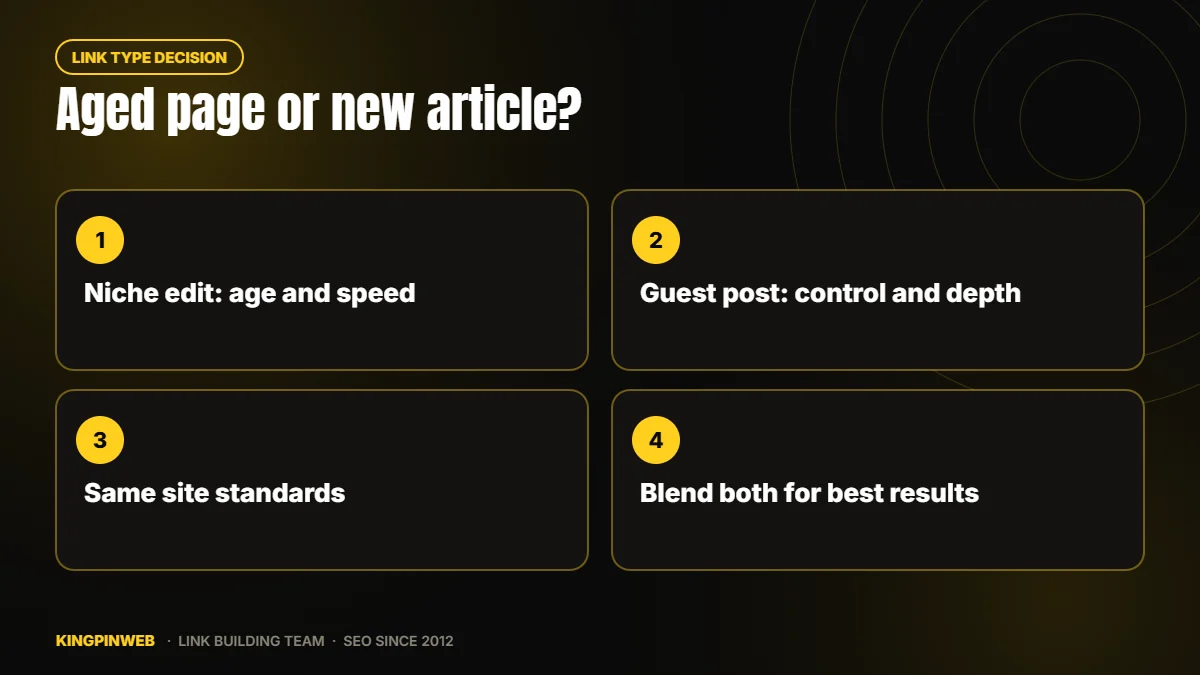
When clients cannot decide, we ask four questions. The answers usually point clearly to one side.
- Is there an existing, relevant article on a strong site that could mention you? If yes, a niche edit is efficient. If your niche is so specific that the answer is no, go with guest posts.
- Do you need results this month or are you building for the year? Short term pushes lean toward niche edits. Long term topical growth leans toward guest posts.
- How important is the exact anchor and its position? If very important, guest posts give you more control.
- What does your current profile lack? Missing aged links points to niche edits. Missing topical context points to guest posts.
If you answer “both” to most of these, that is normal. It usually means a split order is the right call.
A practical example: an online store selling hiking gear might use guest posts on outdoor blogs to support a new category page for ultralight tents, then use niche edits on older camping checklists to push its main backpacks page. Each page gets the link type that suits where it stands today.
Mixing the two for a natural profile
Real websites earn links in many ways: mentions in old articles, features in new ones, profile links, forum mentions and so on. A profile built from only one link type can look manufactured.
A blend we often see working for service sites and ecommerce pages looks like this:
- Guest posts aimed at your key service or category pages, with partial match and topical anchors.
- Niche edits pointed at the same pages a few weeks later, mostly with branded or natural anchors.
- A base of varied foundation links underneath, so the profile does not look top heavy.
For competitive terms, many clients add PBN links on top of this mix for extra power. Each layer has a different job, and together they read like a site that is simply being noticed.
Common mistakes when buying either type
Whichever side of the niche edits vs guest posts question you land on, a few errors waste budget more than anything else. We see them most often with buyers who have been burned by cheap bulk sellers before coming to us.
Judging by one metric
A high DA number alone says little. We look at real referring domains, actual traffic, age and indexing. Trust Flow, Citation Flow and Spam Score are poor guides in our experience.
Ignoring the rest of the page
A guest post on a site where every article carries five commercial links is weak, no matter the metrics. The same applies to niche edits on pages crowded with paid links.
Using the same anchor everywhere
Ten links with the identical exact match phrase look unnatural. Vary branded, partial and natural anchors across both link types.
Expecting overnight results
Most sites see movement over one to three months, depending on competition. We do not guarantee rankings, and nobody honest can, but quality links placed steadily tend to show up in the graphs.
FAQ
Can we choose the topic of our guest post?
Yes. You can share a preferred angle on the order form, and our writers will match it to the host site so it reads naturally to that site’s readers.
Is one type safer than the other?
Both are safe when the sites are real, trafficked and not overloaded with paid links. Risk comes from cheap placements on link farms, not from the format itself.
Do agencies resell these?
Many do. Our reports are unbranded Excel files, so agencies can pass them to clients under their own name and set their own price.
Ready to put both link types to work?
If your pages need topical, handwritten content on real sites, start with our Powerful Guest Posts Links and add niche edits as your campaign grows. Not sure about the split? Message our team with your URL and we will suggest a mix.
About the author

KINGPINWEB Team
KINGPINWEB is an SEO and link building company based in Chennai, India. Since 2012 our in-house team has helped site owners, agencies and businesses rank higher in search. Everything we publish here comes from hands-on work: campaigns we run, rankings we track every day and tests we carry out ourselves. We write these guides to share what works in practice. Our team is led by co-founders Issac M. Paul and Balaji Ragupathi.