Key takeaways
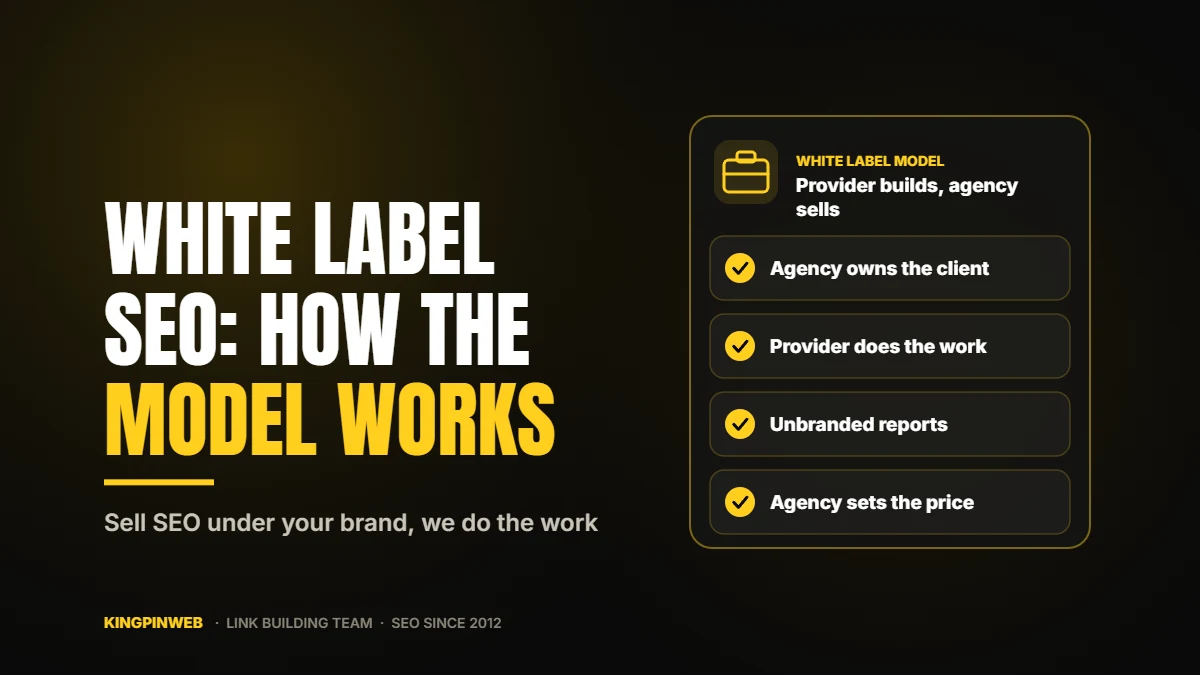
- White label SEO means a provider does the work and an agency sells it under its own brand.
- The agency owns sales, pricing and the client relationship; the provider never contacts the client.
- Reports arrive unbranded, so the agency can add its own logo and commentary.
- Link building is the most commonly white labeled SEO service because the assets take years to build.
- Check sample reports, stated site standards and network privacy before choosing a provider.
White label SEO is an arrangement where one company does the SEO work and another company sells it to clients under its own brand. The client only ever sees the agency they hired. The provider stays in the background, delivers the work and supplies reports with no name or logo of its own.
For agencies, it is a way to offer more services without hiring a full in house team. For providers like us, it means working with agencies who already have the client relationships. Link building is one of the most common services sold this way, and our white label link building program was built around that need.
Here is how the model works from start to finish, what each side is responsible for, and what to check before you sign up with a provider.
How white label SEO works, step by step
The structure is simple once you see who does what. There are three parties: the end client, the agency and the fulfillment provider.
- The agency sells. It pitches SEO to a business, agrees a price and owns the client relationship.
- The agency orders. It places an order with the provider, passing on the target URLs, anchors and any notes about the client’s niche.
- The provider fulfills. The provider’s team does the actual work, such as building links, and keeps quality checks in house.
- The provider reports, unbranded. Reports arrive with no provider name or logo, so the agency can add its own branding.
- The agency presents. The client receives the report from the agency, along with the agency’s own commentary and next steps.
The client pays the agency. The agency pays the provider. The difference is the agency’s margin, and the agency sets its own retail price.
Who does what in the arrangement
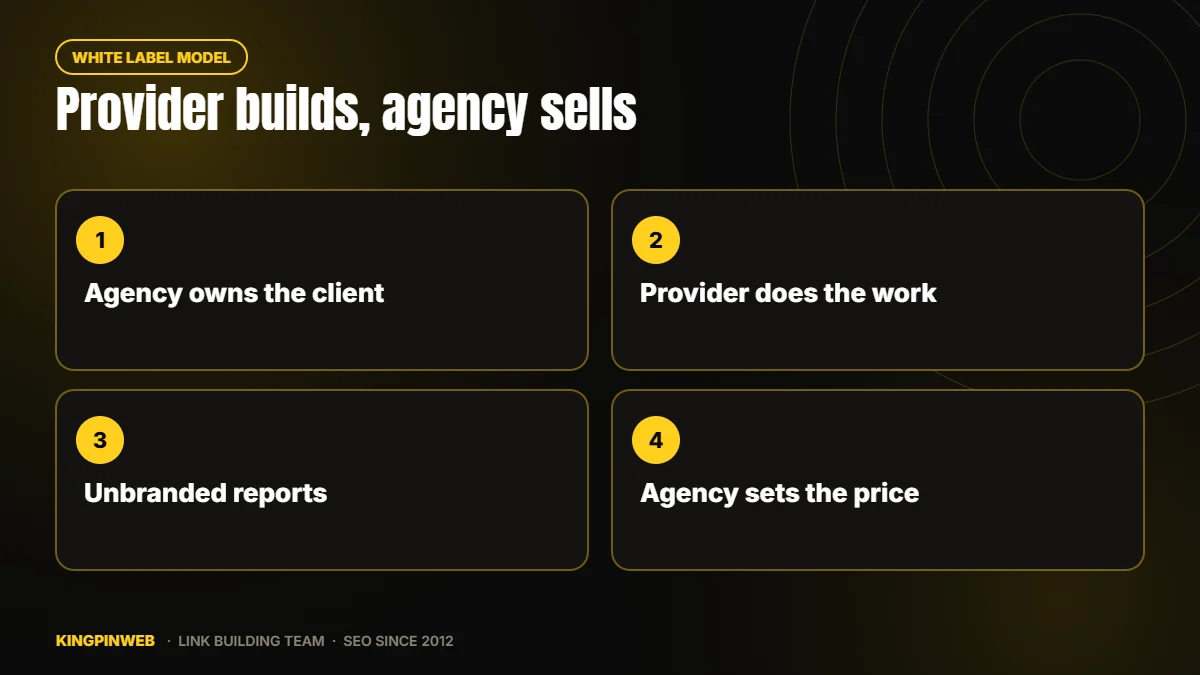
Confusion about roles is the most common reason white label partnerships fail. Being clear from day one avoids awkward moments with end clients.
| Task | Agency | Provider |
|---|---|---|
| Sales and pricing | Yes | No |
| Client calls and strategy | Yes | Advice on request |
| Choosing pages and anchors | Yes, often with provider input | Suggests ratios and mix |
| Doing the work | No | Yes |
| Quality control | Spot checks | Full checks before delivery |
| Reports | Adds branding and commentary | Supplies unbranded data |
A good provider is happy to advise on strategy when asked, but it never contacts your client directly. That boundary is the core promise of the model.
What agencies usually white label
Almost any SEO task can be outsourced this way, but some are much more common because they need specialist skills or assets that are expensive to build.
- Link building. The most outsourced part of SEO by a wide margin. Outreach, site vetting and private networks take years to build.
- Content writing. Blog posts and service pages written to a brief.
- Technical audits. Crawls, speed checks and fix lists.
- Local SEO tasks. Citations and business profile work.
Link building stands out because the asset base matters. We have been building links since 2012 and run 10,000+ PBN sites on aged auction domains, along with relationships for niche edits and guest posts on real sites. An agency starting from scratch cannot replicate that quickly, which is exactly why white label SEO for links makes sense.
Why agencies choose the white label route
We hear the same reasons again and again from agencies that join us.
Hiring is slow and costly
A skilled link builder takes months to find and train, and still needs tools, sites and relationships to be useful. A provider gives you that capacity on the first order.
Demand goes up and down
Client numbers change month to month. With a provider, you pay per order instead of carrying salaries through quiet months.
Focus stays on selling
Agencies grow by winning and keeping clients. Every hour spent chasing link placements is an hour not spent on sales or account management.
Quality is easier to hold steady
A specialist team with a fixed process delivers more consistent results than a rotating set of freelancers.
What to check before choosing a white label SEO provider
Since your brand is on the line, vetting the provider matters more than price. These are the checks we would run ourselves.
- Truly unbranded reports. Ask for a sample. Ours are plain Excel files with no KINGPINWEB name or logo.
- Clear site standards. Look for stated minimums, such as Moz DA, referring domains and traffic, not vague promises.
- Privacy of networks. A provider that publishes its PBN URLs in public exposes your clients. We do not share PBN live URLs, to keep the network private.
- Realistic claims. No honest provider guarantees rankings. Be wary of anyone who does.
- Delivery times. Know the window up front so you can set client expectations. Most of our link services deliver in 7 to 30 days.
- Support access. You need a fast way to ask questions when a client pushes back. We run support chat and handle custom orders directly.
Pricing and margins in practice
There is no fixed markup in white label SEO. Agencies price based on their market, their client’s budget and the value they add on top of the raw work, such as strategy calls and reporting.
What matters is that the provider’s pricing is predictable. Our link packages have published starting prices, for example PBN packages start at $170 and foundation link bundles are $62, so you can build retail packages with a margin you understand before you pitch.
Payment is simple too. Orders are placed and paid in our client portal in USD through PayPal or in INR through Razorpay. If you would rather hand the whole link building function to us rather than order piece by piece, our outsourced link building option covers that.
Mistakes that hurt white label partnerships
Most problems we see come from process, not from the quality of the work itself.
- Overpromising to the client. Selling “page one in 30 days” sets the whole partnership up to fail. Most sites see movement over one to three months, and nobody can guarantee it.
- Sending vague briefs. Missing target URLs or unclear anchors slow delivery. Fill the order form completely and add notes about the niche.
- Reselling without reading the report. Spend a few minutes on each report before forwarding it, so you can answer client questions with confidence.
FAQ
Does the end client ever find out who did the work?
Not from us. We never contact your clients, and nothing in our reports names us. What you share with your clients is up to you.
Can a solo consultant use white label services?
Yes. Many of our partners are freelancers who sell SEO to a few local businesses and need reliable fulfillment without building a team.
Is there a minimum monthly commitment?
No. You order per client and per campaign. Agencies with steady volume often place regular orders, but it is not required.
Ready to sell links under your own brand?
If you want a link building team that stays invisible to your clients and delivers on a clear schedule, see how our white label program for agencies works and place your first order. Questions about volume or custom needs? Reach our support team any time.
About the author

KINGPINWEB Team
KINGPINWEB is an SEO and link building company based in Chennai, India. Since 2012 our in-house team has helped site owners, agencies and businesses rank higher in search. Everything we publish here comes from hands-on work: campaigns we run, rankings we track every day and tests we carry out ourselves. We write these guides to share what works in practice. Our team is led by co-founders Issac M. Paul and Balaji Ragupathi.