Key takeaways
- Niche edit link building adds your link to an existing, indexed article instead of publishing a new post.
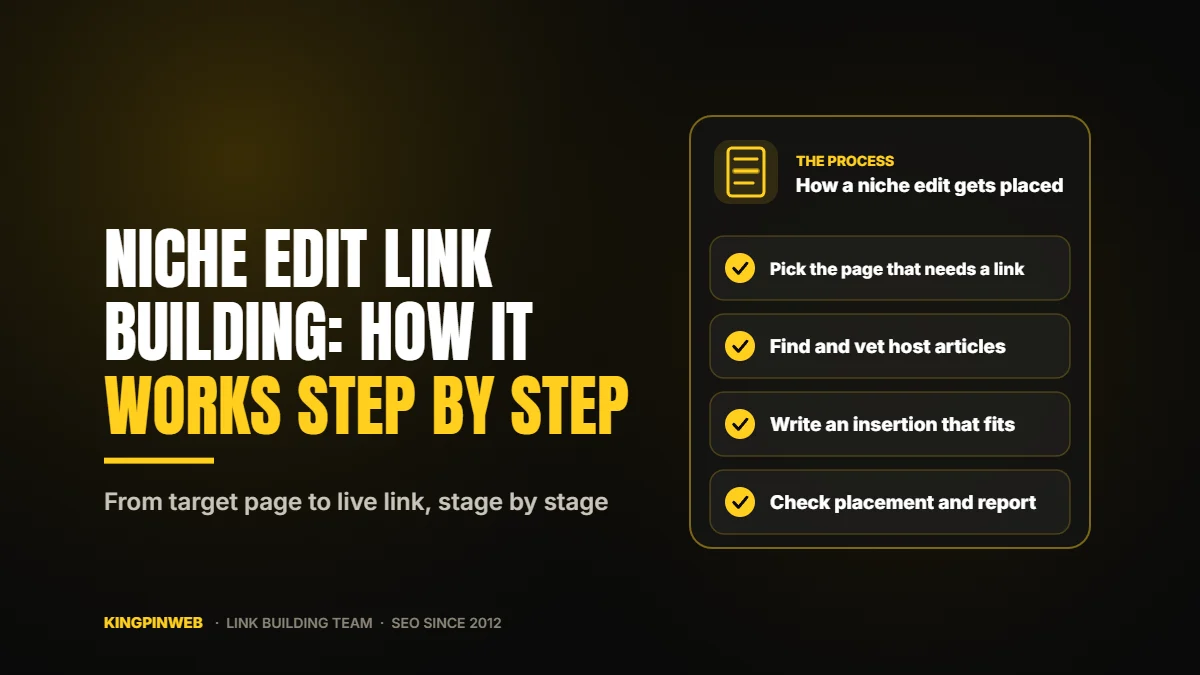
- The work runs in clear stages: pick the target page, find host pages, vet them, write the insertion, check and report.
- Most of the value is decided at the vetting stage: page level links, traffic, outbound link count and topic fit.
- Anchors need to fit someone else’s sentence, so branded and partial match anchors work best.
- Done properly, the process takes skill and relationships, which is why most site owners order it rather than run it in house.
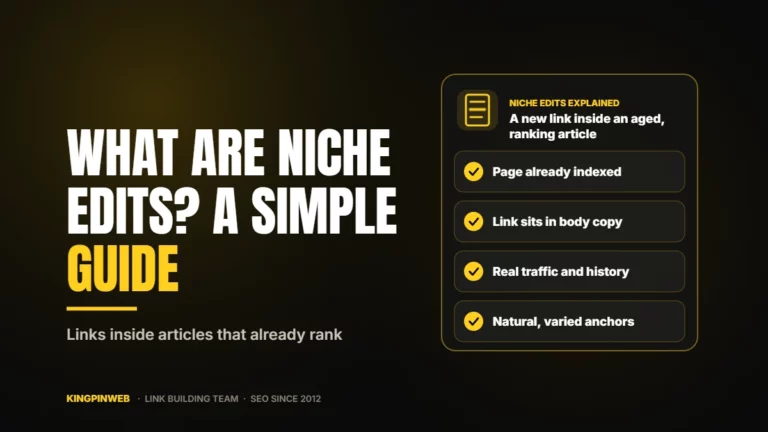
Niche edit link building is the process of getting your link added to an article that already exists on a real website. The page is already published, indexed and often ranking. Your link is worked into the text so it reads naturally and helps the reader.
The idea is simple. The work behind it is not. A good niche edit depends on choosing the right host page, agreeing the change with the site owner, writing an insertion that fits and checking that it holds. Below we walk through each stage the way our team runs it, so you know exactly what you are paying for and what to expect.
If you want the short definition first, read our simple guide to what niche edits are. This post is about how the process works in practice.
Why link building with niche edits works
A brand new guest post starts from zero. It has to be discovered, crawled and indexed, and it has no backlinks of its own. A niche edit skips that wait. The host page already has crawl history, internal links, sometimes its own referring domains and real visitors.
That is why link building with niche edits is so useful for pages that need trusted, relevant signals quickly. Our powerful niche edit links are built around that head start, on sites with Moz DA 20+, 100+ referring domains and 1,000+ monthly traffic.
Niche edit link building step by step
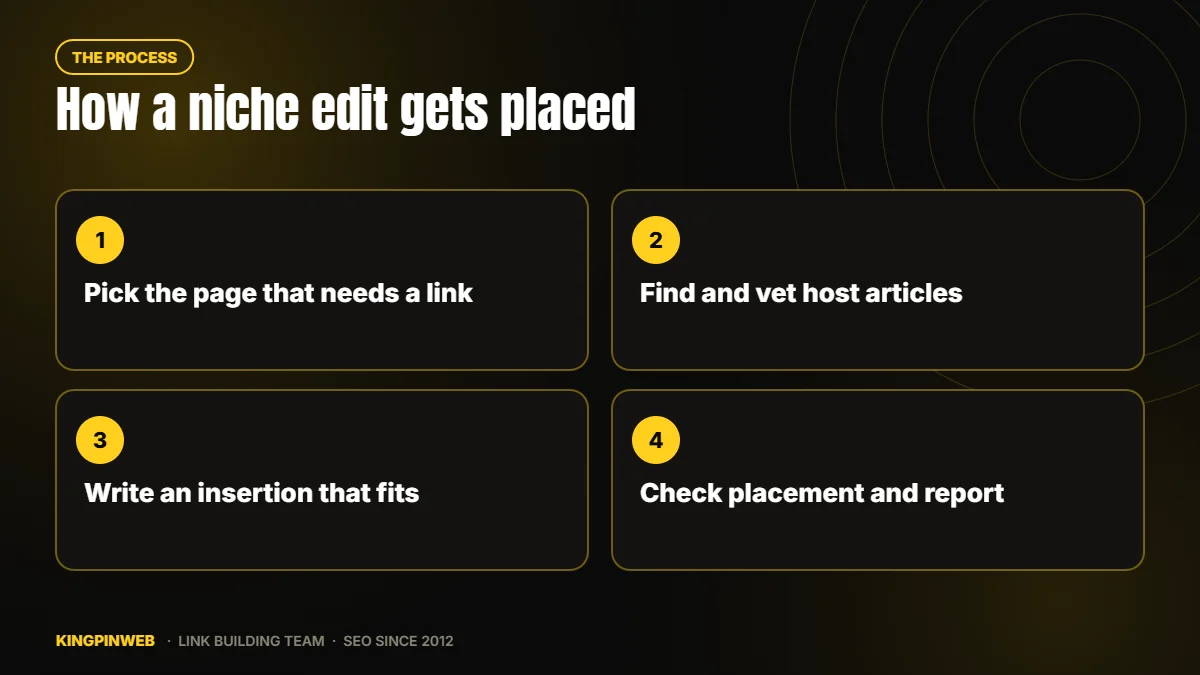
Here is the full process, from your order to the final report.
Step 1: choose the page that needs the link
Everything starts with your target URL. Inner pages that already rank on page two or three usually gain the most, because a relevant link from an established article can be the push they need. We look at what the page is about so the host articles we pick match its topic.
It also helps to decide early how many links the page needs and over what period. A plan of a few edits a month, spread over different sites, looks far more natural than a single burst of links in one week.
Step 2: find candidate host articles
Next we look for articles on real sites that discuss the same subject or a closely related one. A post about kitchen renovation costs can host a link to a plumbing company. A post about retirement savings can host a link to a financial planner. The site does not have to be in your exact industry, but the article must fit.
Step 3: vet each page, not just the domain
This is the stage that decides whether the link is worth anything. For every candidate page we check:
- Indexing: the page must be in the index and ideally ranking for something.
- Page level backlinks: pages with their own referring domains pass more.
- Outbound links: a page already linking out to forty sites dilutes every link on it.
- Site quality: real authors, real content, a reason to exist beyond selling links.
- Click depth: a page buried many clicks from the homepage gets crawled less.
We do not lean on Moz Spam Score, Trust Flow or Citation Flow here. Real backlinks, age, clean history and indexing tell us far more.
Step 4: agree the edit with the site owner
Every niche edit needs the site owner’s agreement. This is where years of relationships matter. Owners of good, established sites are selective about what they add, and they protect their content. Sites that accept any link from anyone are usually the ones you want to avoid.
Step 5: write the insertion
Sometimes the link fits an existing sentence. More often a sentence or short paragraph is added so the link has proper context. The goal is that a reader cannot tell the link arrived later. The new text should add a useful point, not interrupt the article.
Step 6: pick an anchor that fits the sentence
Because the link sits inside someone else’s writing, anchors need to read naturally. Branded anchors, partial match phrases and descriptive text blend in best. Forcing an exact match keyword into an existing paragraph often reads awkwardly and stands out.
Step 7: check placement and report
Once the edit is live, we confirm the link is in the body text, points to the right URL and sits on a page that is still indexed. You then receive an Excel report listing each placement. Reports carry no KINGPINWEB name or logo, so agencies can pass them to clients as their own.
How long the process takes
Our delivery window for niche edits is 7 to 30 days, depending on the package and how specialist your topic is. Common topics move faster. Narrow or regulated niches take longer because fewer good host pages exist.
After placement, the host page is already indexed, so the link is usually picked up quickly. Rankings take longer to respond. Most sites see movement in one to three months, depending on competition. We do not guarantee rankings.
What makes the process hard to run in house
| Stage | What it takes | Where it goes wrong |
|---|---|---|
| Finding hosts | Hours of searching per topic | Settling for unrelated pages |
| Vetting | Checking links, traffic and indexing by hand | Trusting a domain score alone |
| Agreeing edits | Relationships with real site owners | Ending up on link farms |
| Writing | Insertions that match the article’s voice | Links that look bolted on |
| Checking | Confirming placement and indexing | Paying for links nobody counts |
Each stage is manageable alone. Together, when niche edit link building has to run for several pages, with dozens of links a month, the stages become a full time job. That is the work our in house team in Chennai has done since 2012.
Where niche edits fit in a wider campaign
Niche edits are strongest for relevance and trust. They pair well with other link types:
- Foundation links to give a new site a natural base first.
- Guest posts when you want a full article built around your topic.
- PBN links when a competitive keyword needs direct ranking power. Our PBN links guide explains how they work.
A mixed profile looks more natural than any single type and spreads the work across different signals.
FAQ
Can several niche edits point to the same page?
Yes. Spreading them across different host sites and adding them over a few weeks looks more natural than placing them all at once.
Can a homepage be the target of a niche edit?
It can, but inner pages usually benefit more because the topical match between the host article and the target is closer.
What happens if a host article is later updated?
Site owners refresh their content from time to time. We work with owners who keep placements in place during updates, and established sites rarely strip out links that fit the text.
Do you need to supply the insertion text?
No. Send your target URL and preferred anchors on the order form, and our team writes text that fits each host article.
Ready to add links to pages that already rank?
Skip the searching, vetting and outreach. Order niche edits from our team through the client portal, paying in USD by PayPal or INR by Razorpay, or talk to us about the right mix for your site.
About the author

KINGPINWEB Team
KINGPINWEB is an SEO and link building company based in Chennai, India. Since 2012 our in-house team has helped site owners, agencies and businesses rank higher in search. Everything we publish here comes from hands-on work: campaigns we run, rankings we track every day and tests we carry out ourselves. We write these guides to share what works in practice. Our team is led by co-founders Issac M. Paul and Balaji Ragupathi.