Key takeaways
- What are backlinks? Links from other websites to yours, which search engines treat as votes of trust.
- Backlinks remain one of the strongest ranking signals in SEO, alongside content and relevance.
- Quality beats quantity: one link from a strong, relevant, indexed page outweighs dozens of weak ones.
- Dofollow links pass ranking credit; nofollow links are hints that keep a profile natural.
- How many you need depends on what the pages ranking above you already have.
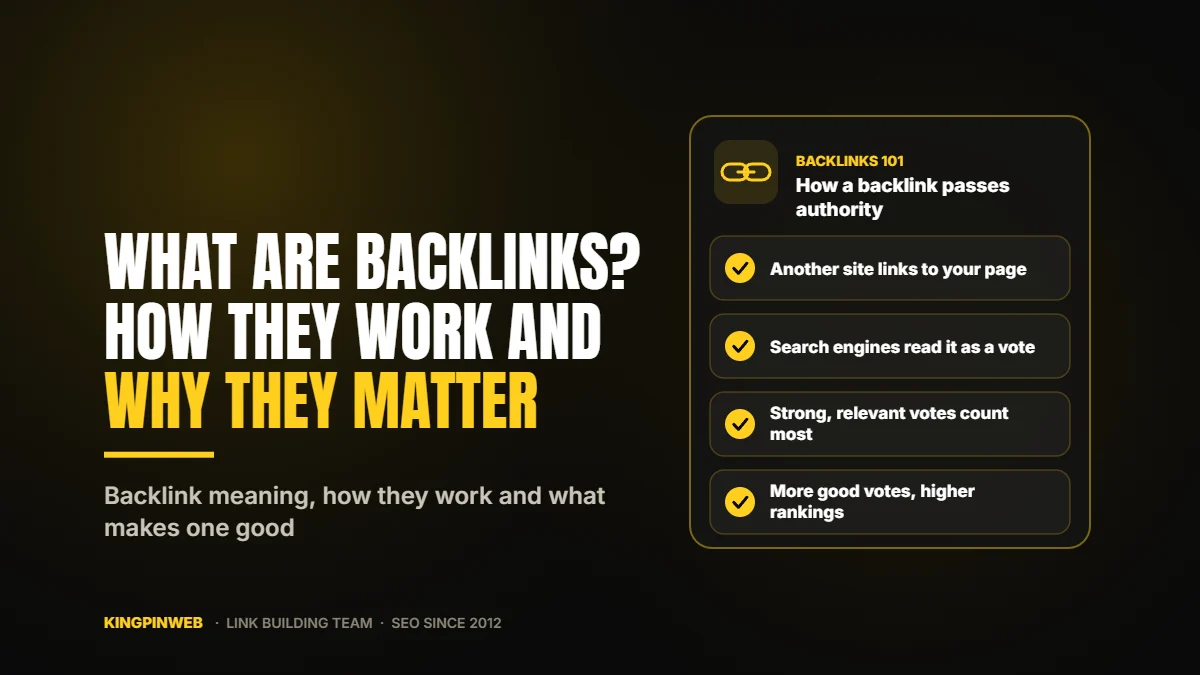
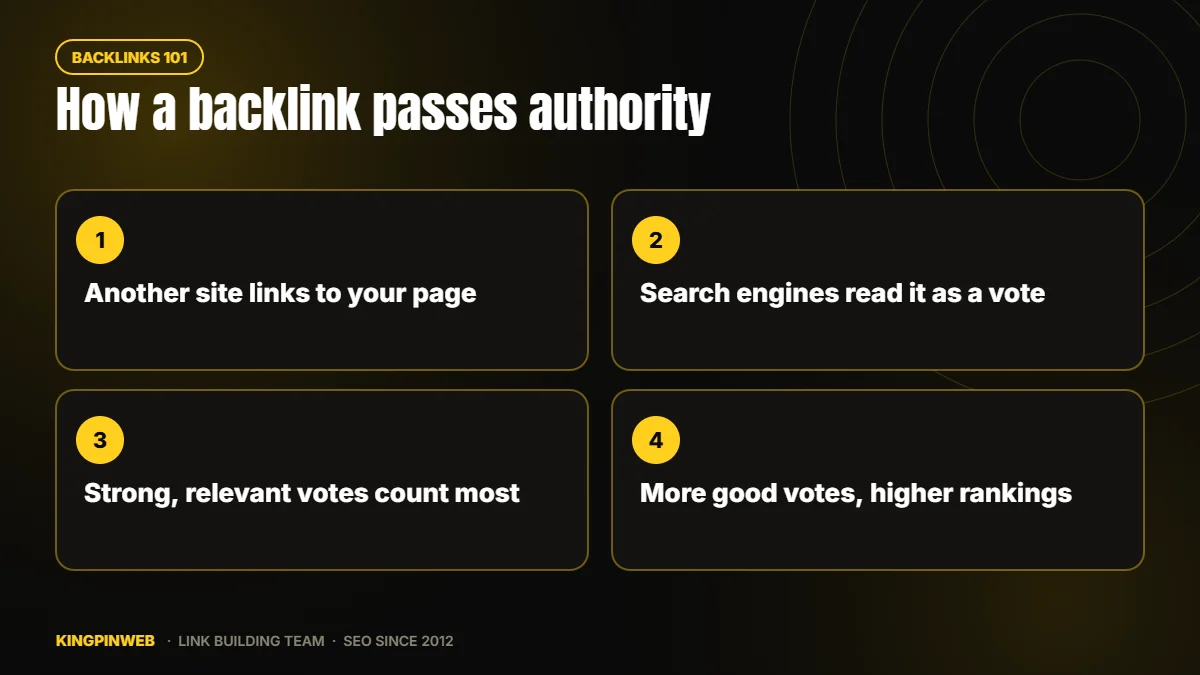
What are backlinks? A backlink is a link on another website that points to a page on yours. When a site links to you, it is telling its readers, and search engines, that your page is worth visiting. Search engines count those links as votes, and pages with more strong votes tend to rank higher.
That simple idea sits at the heart of how search works, and it is why backlinks in SEO get so much attention. We have been building links for clients since 2012, and in all that time, links have stayed one of the clearest differences between pages that rank and pages that do not.
This guide covers the backlink meaning in plain English, how search engines use links, what makes one link better than another, the main types and how many your site needs. If you already know the basics and want links built for you, our link building services cover every type mentioned here.
What is a backlink? The simple definition
A backlink, also called an inbound link or incoming link, is any clickable link on one website that leads to another. If a food blog writes “this cast iron skillet guide is the best we have read” and links those words to your page, that is a backlink for you.
Every backlink has three parts:
- The linking page: the page where the link appears. Its strength and topic matter most.
- The anchor text: the clickable words. They tell search engines what your page is about.
- The target page: the page on your site the link points to.
The number of different websites linking to you is called your referring domains. Ten links from ten different sites usually count for more than ten links from one site, so referring domains are one of the most useful numbers in any backlink data you look at.
What are backlinks in SEO used for?
Search engines were built on a simple insight: the web’s own links reveal which pages people trust. A page that many respected sites link to is probably useful. That idea became the PageRank system, and links have been part of ranking ever since.
Today, search engines use backlinks in three main ways:
- Authority: links pass a share of the linking page’s strength to yours. Strong pages pass more.
- Relevance: the topic of the linking page and the anchor text help search engines understand what your page covers.
- Discovery: crawlers follow links to find new pages, so links also help your pages get found and indexed.
Content still matters enormously. A thin page with lots of links rarely holds top positions. But when two pages are similarly useful, the one with the stronger backlink profile usually wins. That is why SEO and backlinks are almost always discussed together.
Dofollow vs nofollow backlinks
Website owners can tag links to change how search engines treat them. The two terms you will see most often:
- Dofollow: a normal link with no restricting tag. It passes ranking credit in full. Most of the ranking benefit from backlinks comes from these.
- Nofollow: a link with rel=”nofollow” (or the related “sponsored” and “ugc” tags). It asks search engines not to count it as an endorsement. Since 2019 these have been treated as hints, so some may still count.
Real websites earn both kinds. Comments, forums and social profiles are usually nofollow; editorial articles are usually dofollow. A healthy profile has a natural mix, and a profile with no nofollow links at all can look built rather than earned.
What makes a good backlink?
Not all links are equal. One link from a strong, relevant page can outweigh hundreds of weak ones. These are the qualities we look at first:
| Quality | Why it matters | What to look for |
|---|---|---|
| Real authority | Stronger sites pass more value | Genuine referring domains, not just a high score |
| Age and clean history | Long established sites carry more trust | Years online, no spam or abandoned periods |
| Indexing | A page that is not indexed passes nothing | The linking page shows up in search |
| Relevance | Helps search engines read your topic | Related content around the link |
| Placement | Links inside the main text count most | Contextual link, not a footer or widget |
| Outbound links | Value is shared among every link on a page | A page that links out sparingly |
A note on metrics: scores like DA and DR are useful shorthand, but we do not rely on Moz Spam Score, Trust Flow or Citation Flow, which mislead in both directions. Real backlinks, age, clean history and indexing tell you far more.
The main types of backlinks
Website backlinks come in many forms. These are the ones most site owners deal with:
Editorial links
Links another site adds on its own because your content is useful. The ideal, but hard to earn at scale and slow for new sites.
Guest posts
You, or a provider, write an article for another site, and it includes a link to you. A solid way to get contextual links on real sites with real traffic.
Niche edits
A link added to an existing, already indexed article on a real site. Because the page has age and links of its own, the backlink often takes effect sooner.
PBN links
Links from a private blog network: sites built on aged expired domains that already carry authority. Strong and controllable when the network is built well. Our guide to PBN links explains how they work.
Foundation links
Profile, forum, Web 2.0, bookmarking, PDF and comment links. Not powerful one by one, but they give a site a broad, natural base, especially a new site.
Directory and citation links
Listings in business directories and local citation sites. Most useful for local businesses when the directories are real and relevant.
Backlinks that can hurt
Some links do more harm than good. Search engines discourage links that exist only to manipulate rankings, and the patterns they look for are easy to spot:
- Thousands of links from obvious spam sites or automated tools.
- Pages stuffed with dozens of unrelated outbound links.
- Exact match keyword anchors on almost every link.
- Sudden huge spikes of links with no reason behind them.
The risk comes from cheap, sloppy link sources, not from link building itself. Careful work with real sites, varied anchors and steady pacing is what keeps a profile healthy.
How to get backlinks
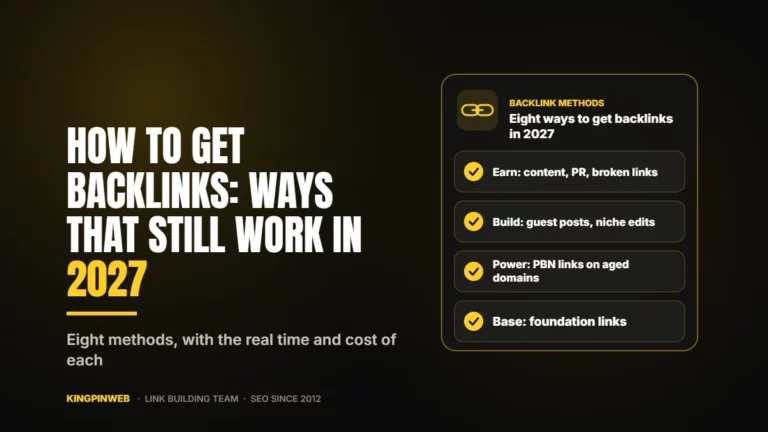
There are two broad routes. You can earn links by publishing content people want to reference and promoting it through outreach and digital PR. Or you can build them through guest posts, niche edits, PBN links and foundation links.
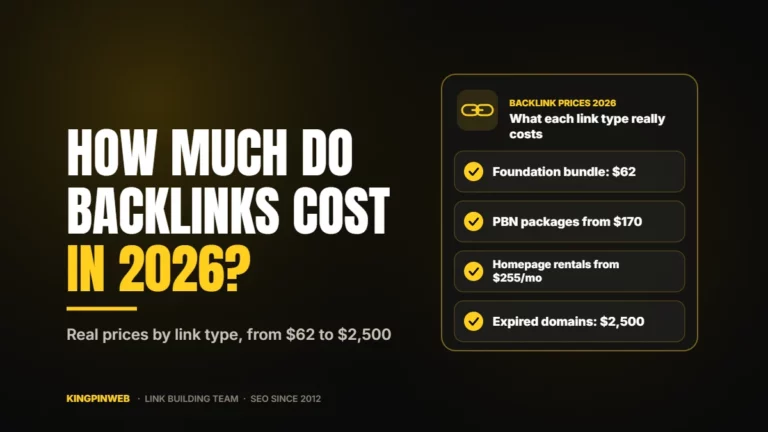
Earning links is valuable but slow and unpredictable. Building them is faster and more controllable, which is why most businesses and agencies use a mix and order part of the work from specialists. Our guide to how much backlinks cost lays out typical budgets.
For a new site, we usually suggest starting with a natural base, such as our 230 hand built foundation backlinks for $62, then adding stronger contextual links on top.
How many backlinks do you need?
There is no universal number. The answer depends on your keyword and the pages already ranking for it. A local plumber in a small town may need a handful of good links. A national ecommerce category may need many more.
The most reliable way to estimate is to look at the top results for your main keyword and note how many referring domains their ranking pages have. You do not need to match the leader link for link, but you need to be in the same range, with links of similar or better quality.
Pace matters as much as the total. A site that gains links steadily month after month looks like a business growing its reputation. A site that gains hundreds overnight and then nothing looks like a campaign.
Keyword difficulty scores in SEO tools are a rough guide at best; in our experience they are often wrong. Looking at the real competition tells you far more. Then build at a steady pace, watch your positions and adjust. Most sites see movement within one to three months once quality links start landing.
FAQ
Is a backlink the same as an internal link?
No. A backlink comes from another website. An internal link connects two pages on your own site, which helps share authority but does not add new votes from outside.
Do backlinks still matter in 2026?
Yes. Search engines have added many signals over the years, but links from trusted sites remain one of the clearest signs that a page deserves to rank.
How long does a backlink take to work?
The link has to be crawled and indexed first, which can take days to weeks. Ranking effects usually build over the following weeks.
Can you check who links to your site?
Yes. Search Console shows many of your links for free, and paid SEO tools show more detail, including referring domains and anchor text.
Ready to build backlinks that move rankings?
Now that you know what backlinks are and what makes one count, the next step is getting the right ones. Browse our backlink packages, from foundation links to PBN links, guest posts and niche edits, or ask our team to suggest a mix for your site.
About the author

KINGPINWEB Team
KINGPINWEB is an SEO and link building company based in Chennai, India. Since 2012 our in-house team has helped site owners, agencies and businesses rank higher in search. Everything we publish here comes from hands-on work: campaigns we run, rankings we track every day and tests we carry out ourselves. We write these guides to share what works in practice. Our team is led by co-founders Issac M. Paul and Balaji Ragupathi.