Key takeaways
- Dental searches show two sets of results: the map pack and the organic listings below it, and both are worth winning.
- Your Google Business Profile, reviews and address details drive the map pack; your website authority drives the organic results.
- Separate pages for high value treatments like implants, Invisalign and veneers rank and convert far better than one long services page.
- In busy cities, most clinics have similar websites, so backlinks are usually the deciding factor for page one.
Dental SEO is how a clinic gets found when someone in its city searches “dentist near me”, “dental implants Austin” or “emergency dentist open Saturday”. Done well, it brings a steady flow of new patients who are already looking to book.
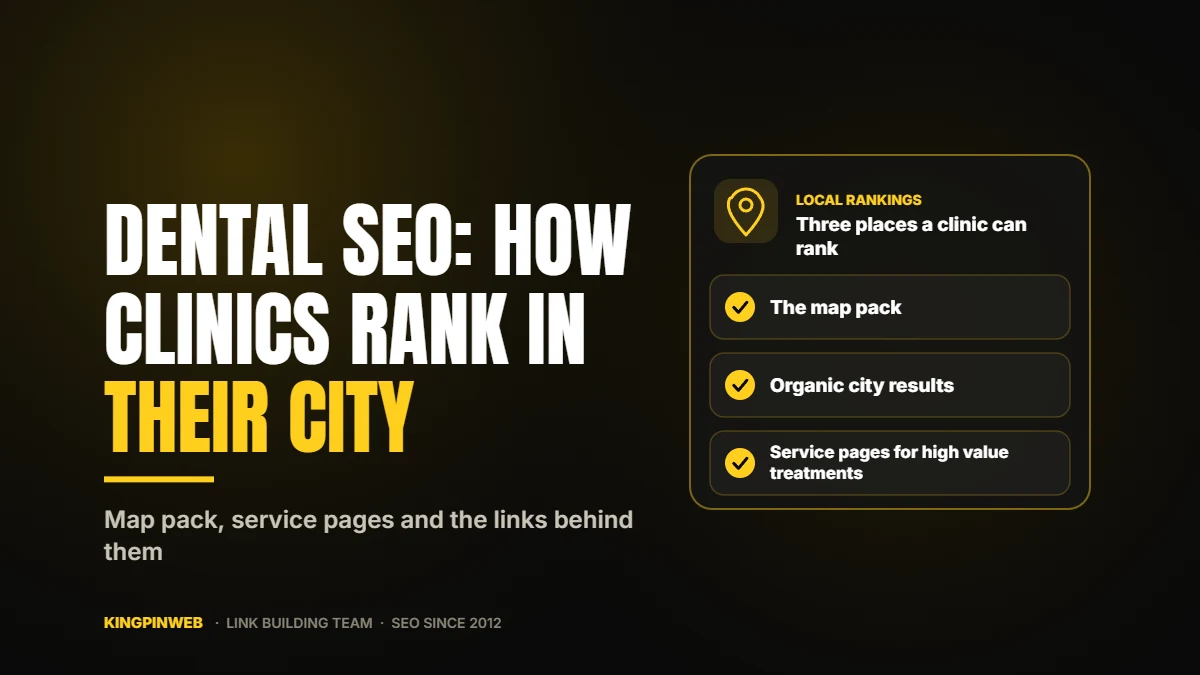
Ranking in your city comes down to three things: a complete and well reviewed Google Business Profile, a website with a clear page for each treatment, and enough authority in the form of backlinks to beat the other clinics nearby. The first two are table stakes. The third is where most practices fall behind.
We build links for clinics and the agencies that serve them. Here is how we see the full picture, and where our link building for dentists fits.
How patients search for a dentist
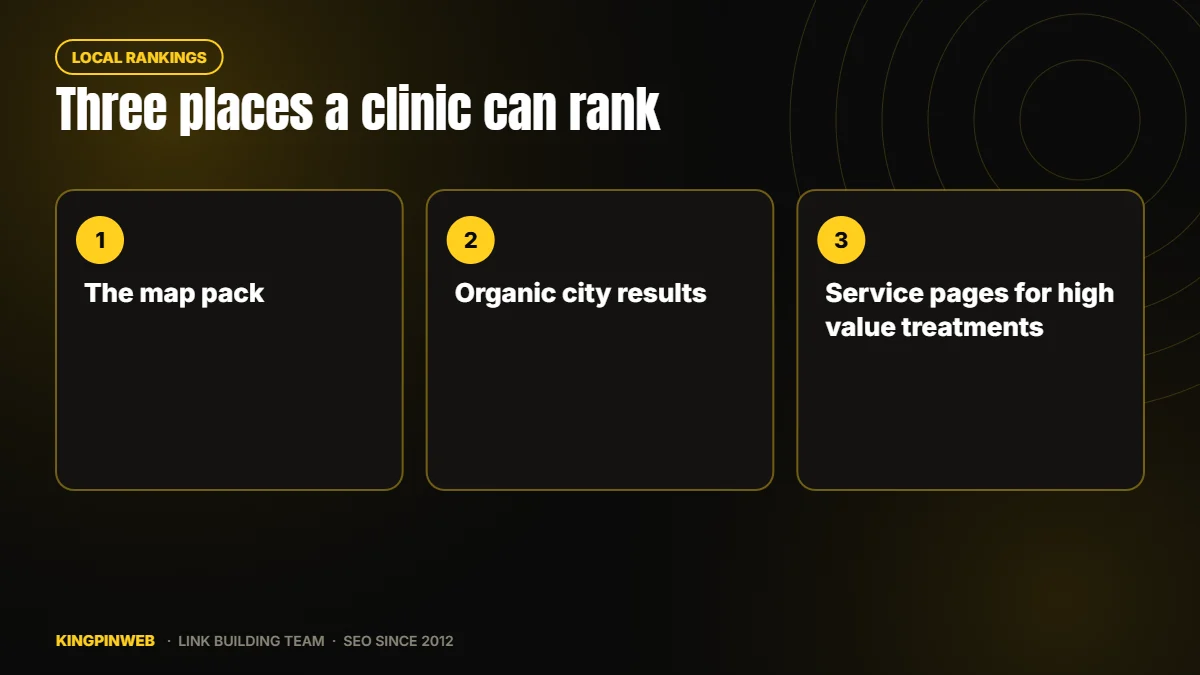
Dental searches fall into a few clear groups, and each needs a slightly different approach:
- Urgent searches: “emergency dentist”, “toothache dentist open now”. These people call the first clinic that looks available.
- General searches: “dentist near me”, “family dentist in Tampa”. Reviews and distance matter most here.
- Treatment searches: “dental implants cost Denver”, “Invisalign provider Phoenix”. These are research heavy and worth thousands of dollars per patient.
- Cosmetic searches: “veneers”, “teeth whitening”, “smile makeover”. Visitors compare before and after photos and prices.
Treatment and cosmetic searches carry the highest value per patient. They are also where organic rankings, not just the map pack, make the biggest difference.
Winning the map pack
The map pack is the box of three clinics shown with a map at the top of local results. It is driven mainly by your Google Business Profile. The basics that matter:
- Choose the right primary category, usually “Dentist”, plus secondary categories for specialties you actually offer.
- Keep your clinic name, address and phone number identical everywhere they appear online.
- Ask every happy patient for a review and reply to each one, good or bad.
- Add real photos of the clinic, the team and the equipment.
- Post updates and list services with short descriptions.
Distance from the searcher also plays a big role, and you cannot change where your building is. That is why the organic results below the map matter so much. They reach patients across the whole city, not just those within a mile of your door.
Building a dental website that ranks
Many clinic websites are attractive but thin. One page lists twenty services in bullet points, and that page cannot rank for twenty different searches. A site built for dental SEO gives each important treatment its own page.
| Page | What it should cover | Search it targets |
|---|---|---|
| Dental implants | Process, candidates, recovery, cost range, financing | “dental implants [city]” |
| Invisalign or clear aligners | Who it suits, timeline, comparison with braces | “Invisalign [city]” |
| Emergency dentistry | Hours, what counts as an emergency, how to reach you | “emergency dentist [city]” |
| Cosmetic dentistry | Veneers, whitening, bonding, photo gallery | “cosmetic dentist [city]” |
| Location page | Address, parking, neighborhoods served, map | “dentist [neighborhood]” |
Each page should be written by or reviewed by a dentist on the team, mention the dentist by name and credentials, and answer the questions patients actually ask at consultations. Fast loading on mobile matters too, because most dental searches happen on a phone.
Why links decide dental SEO in competitive cities
In a small town, a clean profile and a decent website can be enough. In a large metro area, dozens of clinics have done the same work. They all have reviews, service pages and mobile friendly designs.
When the on page work is equal, authority breaks the tie. The clinic whose implant page has more strong, relevant links pointing to it tends to sit above the rest. Big dental groups and franchise chains know this, which is why their pages often outrank independent practices with better reviews.
Clinics rarely earn links naturally. Few people link to a dentist’s implants page on their own. That leaves a gap only deliberate link building fills.
What a dental link campaign looks like
We build a mix of links that suits medical and local businesses:
- Contextual PBN links from our network of 10,000+ sites on aged domains, placed inside handwritten articles about health, oral care or family life, aimed at your highest value treatment pages.
- Niche edits on existing health and lifestyle articles that are already indexed and trusted.
- Guest posts on real sites with traffic, covering topics like caring for implants or choosing between aligners and braces.
- Foundation links to give the whole domain a natural base of profile, forum and Web 2.0 links. Our update-proof foundation backlinks are a low cost way to start.
We point most links at treatment pages rather than the homepage. The homepage usually ranks for the clinic name already, while the implant or Invisalign page is where new revenue comes from.
Anchor text for clinics
Keep anchors natural. Use the clinic name, the dentist’s name, the URL and general phrases like “this clinic” or “their implant team”. Only a small share should read like “dental implants in Austin”. Overusing exact city and service phrases looks unnatural.
Common dental SEO mistakes we see
When clinics or their agencies come to us, the same problems show up again and again:
- Stock photos everywhere. Patients want to see the real clinic and the real dentist. Generic smiling models erode trust.
- Prices hidden completely. You do not need exact prices, but a cost range or financing note keeps implant and aligner visitors on the page longer.
- Several clinics on one page. Groups often list all locations on one page, which ranks for none of the cities well.
- Buying cheap bulk links. Thousands of spammy directory or comment links can drag a site down. Quality, relevant placements are what move a clinic forward.
- Stopping too early. Many practices pause after six weeks because nothing moved yet. Authority builds over months, not days.
Timeline and realistic expectations
We usually see treatment pages start to move within one to three months after links go live, with steadier gains through months three to six. Competitive cities and high value treatments take longer than suburbs and general searches.
We do not promise rankings. We do promise handwritten content, links that stay live, and an unbranded Excel report you can share with the clinic owner. For agencies, that makes the work easy to resell.
FAQ
Do multi location dental groups need separate pages per clinic?
Yes. Each location needs its own page with its own address, team and photos, and its own Google Business Profile. Links can then be spread across location pages based on which city needs the most help.
Are paid ads a substitute for organic rankings?
Ads bring calls quickly, but costs per click for implants and Invisalign are high and stop the moment the budget ends. Organic rankings keep bringing patients without a per click cost, so most clinics run both.
Do patient reviews on other sites help?
Reviews on healthcare directories and social platforms add trust and sometimes appear in search results. Your Google reviews still carry the most weight for the map pack.
Ready to fill your appointment book from search?
If your clinic has the reviews and the service pages but still sits behind the big groups, authority is the missing piece. See our dental link building plans or contact our team to plan links for your top treatment pages.
About the author

KINGPINWEB Team
KINGPINWEB is an SEO and link building company based in Chennai, India. Since 2012 our in-house team has helped site owners, agencies and businesses rank higher in search. Everything we publish here comes from hands-on work: campaigns we run, rankings we track every day and tests we carry out ourselves. We write these guides to share what works in practice. Our team is led by co-founders Issac M. Paul and Balaji Ragupathi.