Key takeaways
- Searches like “[competitor] alternatives” and “X vs Y” come from buyers who are ready to switch or sign up.
- Review sites and listicles own most of these results because they have far more referring domains than a single SaaS page.
- Good content gets a comparison page indexed; backlinks pointed at the page itself are what move it into the top three.
- Build one page per competitor, keep it fair and current, and link it from your product and pricing pages.
- A steady mix of PBN, niche edit and guest post links works well for comparison pages because they rarely earn links naturally.
SaaS comparison page SEO is the work of getting your “vs” and “alternatives” pages to rank for the searches buyers type right before they choose a tool. Think “Asana alternatives”, “HubSpot vs Pipedrive” or “cheaper alternative to Hotjar”. The people behind those searches already know the category. They are picking a winner.
The short version: a comparison page needs honest, structured content to get indexed and trusted, and it needs links aimed directly at it to beat the review sites that sit on page one. Most SaaS teams do the first part well and skip the second, which is why their best converting pages sit on page two.
Below we walk through how these pages rank, what to put on them, and how our link building service for SaaS companies pushes them up.
Why vs and alternatives searches are worth the effort
Most SaaS content targets the top of the funnel. Guides, templates and “what is” posts bring traffic, but readers are months from buying.
Comparison searches are the opposite. Someone typing “Calendly alternatives” is unhappy with a tool they pay for, or about to pay for. Someone typing “Notion vs Coda” has a shortlist of two. These searches have lower volume, but the visitors convert into trials at a much higher rate.
There are three main page types worth building:
- Alternatives pages: “[Competitor] alternatives”, where you present your product as the leading option among several.
- Head to head pages: “[Your product] vs [Competitor]”, a direct comparison.
- Third party comparisons: “[Competitor A] vs [Competitor B]”, where you join a conversation that does not name you yet and position yourself as the third choice.
Who you are really competing against on page one
Look at the results for almost any “alternatives” query and you will see the same pattern. Software review directories, large listicle publishers and big tech blogs fill most of the first page. The competitor itself often ranks for its own “vs” terms.
These sites win for one main reason: authority. A review directory has tens of thousands of referring domains pointing at the whole site, and that strength flows into every category and comparison page it publishes. Your comparison page, sitting on a SaaS domain with a few hundred referring domains, starts far behind.
Content quality closes some of the gap. Searchers and search engines both like a page that actually answers the question from someone who knows the product. But on competitive terms, content alone rarely gets a SaaS page past a directory with fifty times the link equity.
What to put on a comparison page that ranks
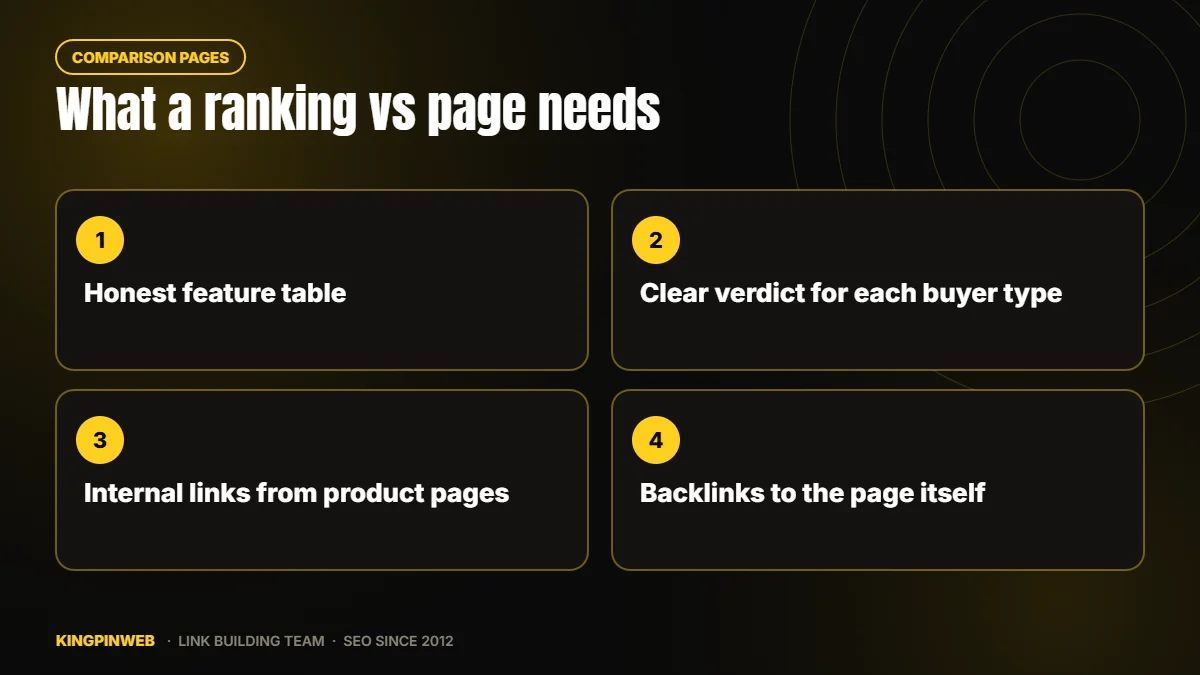
Before you build a single link, the page itself has to deserve the position. We see the same elements on comparison pages that hold their rankings:
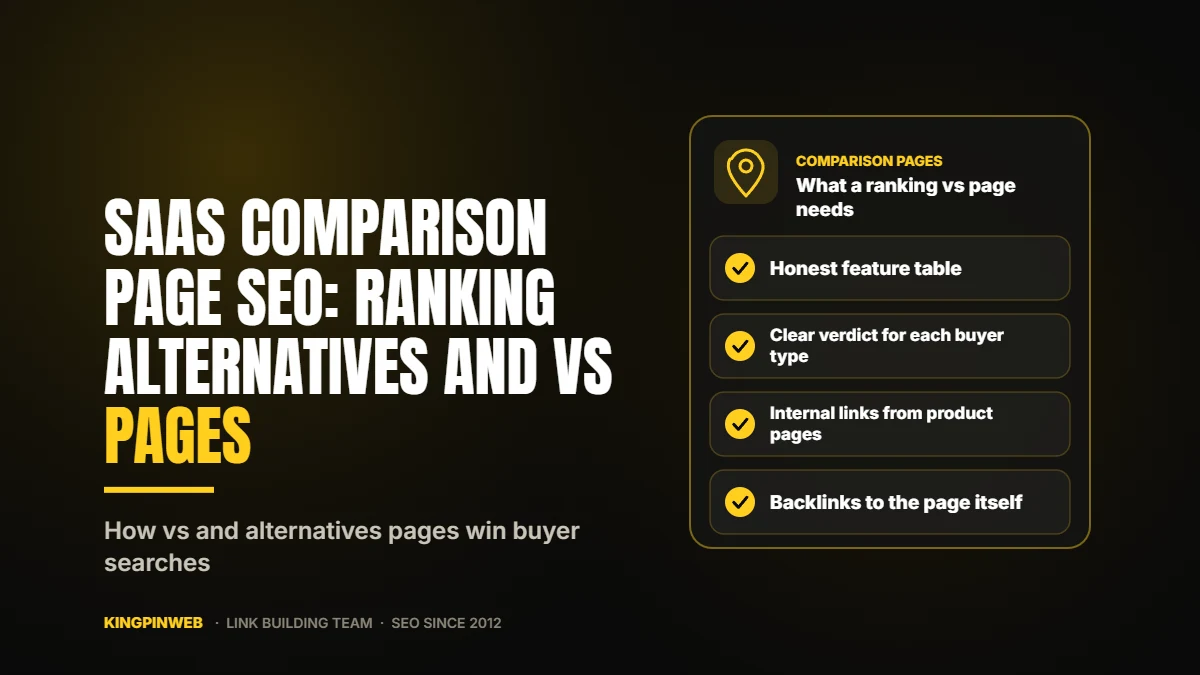
- A fair summary at the top. Two or three sentences on who each tool suits best. Readers trust a page that admits the competitor is better for some use cases.
- A feature and pricing table. Plain rows, real plan names, current prices. Update it when either side changes pricing.
- Sections by buyer type. “Best for small teams”, “best for enterprise”, “best if you need integrations”. This matches how people actually decide.
- Migration details. If you offer import tools or free onboarding for switchers, say so clearly. It is often the deciding factor.
- A dated update note. Comparison content goes stale fast. Showing when it was last checked builds trust.
Avoid the common mistake of writing a page that only praises your own product. Thin, one sided pages tend to bounce visitors quickly and rarely hold a top position for long.
SaaS comparison page SEO: the link gap
Here is the core problem. Comparison pages almost never earn links on their own. Journalists do not cite a vendor’s “us vs them” page. Bloggers link to neutral review sites instead. So the page that matters most for revenue is often the page with zero external links.
That is where deliberate link building comes in. Internal links from your homepage and product pages help, but they only redistribute authority you already have. To move past a directory, the page needs fresh, relevant external links pointing straight at its URL.
| Ranking factor | Review directory | Typical SaaS vs page |
|---|---|---|
| Referring domains to the site | Very high | Low to medium |
| Links to the exact page | Some, from category links | Usually none |
| Product depth | Shallow, many tools | Deep, first hand |
| Freshness | Varies | Easy to keep current |
The table shows where you can win. You already beat the directories on depth and freshness. Close the link gap to the page and you have a real shot at the top three.
Which links work best for comparison pages
We usually combine three link types for SaaS clients, each doing a different job.
PBN links for direct ranking power
Our network of 10,000+ PBN sites is built on aged expired domains with real backlink history. A contextual link inside a handwritten article on a relevant topic, such as productivity or sales software, sends strong authority straight to the comparison URL. This is usually the fastest mover. Our guide to PBN links explains how they work if you are new to them.
Niche edits for topical trust
Links placed inside existing, indexed articles on real sites about software, remote work or business tools add relevance signals. The page around the link is already trusted, which helps.
Guest posts for brand mentions
A guest post that discusses your category and links to your comparison page adds a natural looking editorial link and puts your brand in front of real readers.
For anchor text on comparison pages, keep it varied. Use your brand name, the page URL, phrases like “a full comparison” and only a small share of exact phrases such as “Trello alternatives”.
Building a comparison page program, not a single page
One comparison page is a test. A set of them is a channel, and SaaS comparison page SEO pays off most when the pages support each other. The SaaS teams that get the most from this work treat it as a program:
- List every competitor buyers mention on sales calls and in churn surveys.
- Build one alternatives page and one head to head page for the top five.
- Link them together in a “compare” hub, and link that hub from the main navigation or footer.
- Point links at the pages with the highest trial potential first, then work down the list.
- Review rankings monthly and add links where a page stalls between positions four and ten.
Pages stuck between four and ten are usually the best use of a link budget. They have proven relevance and only need extra authority to jump.
How long it takes and what to expect
For less competitive “alternatives” terms, we usually see movement within one to three months of links going live. Head to head pages against the biggest names take longer because the competitor’s own domain is so strong.
We do not guarantee rankings, and nobody honest can. What we can say is that comparison pages respond well to links because their content is already highly relevant. The missing piece is almost always authority. If you run an agency handling several SaaS clients, our white label link building lets you deliver this work under your own brand with unbranded reports.
FAQ
Should a comparison page be on the main domain or a subfolder?
Keep it on your main domain, ideally in a folder like /compare/ or /alternatives/. Subdomains and separate microsites start with little authority and split your link equity.
Is it legal to use a competitor’s brand name on a comparison page?
Comparative content using brand names is common practice, but keep claims accurate and fair. Many SaaS teams have legal review the first page before scaling the format.
Should comparison pages be noindexed for paid traffic only?
No. Organic comparison traffic is usually cheaper and converts just as well as paid. Index the pages and use the same URL for both channels.
How many links does one comparison page need?
It depends on the keyword and the sites above you. A long tail alternatives term may move with a handful of strong links, while a big brand vs query can need a steady campaign over several months.
Ready to push your comparison pages onto page one?
Your vs and alternatives pages already speak to buyers who are ready to sign up. Give them the authority to be seen. See how our SaaS link building packages work, or talk to our team about a custom plan for your comparison pages.
About the author

KINGPINWEB Team
KINGPINWEB is an SEO and link building company based in Chennai, India. Since 2012 our in-house team has helped site owners, agencies and businesses rank higher in search. Everything we publish here comes from hands-on work: campaigns we run, rankings we track every day and tests we carry out ourselves. We write these guides to share what works in practice. Our team is led by co-founders Issac M. Paul and Balaji Ragupathi.