Key takeaways
- A good link building strategy for a small business starts with choosing two or three money pages, not with buying links.
- Build a cheap, natural foundation layer first, then add stronger contextual links to the pages that bring revenue.
- Consistency beats bursts: a steady monthly budget usually outperforms one big spend followed by nothing.
- Track rankings for each target page and move budget toward the pages that respond.
- Outsourcing saves owners the months it takes to learn outreach, vet sites and write content.
A link building strategy for a small business has to do more with less. You do not have the budget of a national brand or the time to run outreach campaigns. You need a plan that puts each dollar where it moves rankings and leads.
The plan we recommend is simple. Pick the pages that make you money, give the whole site a natural base of links, then point stronger contextual links at those money pages month after month. Adjust based on what moves.
Below is the six month approach we use with small business clients, along with how to budget it. Every service mentioned is available in our link building shop.
If you want the background first, see our plain English guide to backlinks.
Step zero: decide what the links are for
Most small business owners start by asking “how many links does the site need?” The better question is “which pages need to rank?”
Look at your site and pick two or three pages that, if they ranked, would bring calls, bookings or sales. For a plumber, that might be the “water heater repair” and “emergency plumber” pages. For an online store, it might be two category pages. For a consultant, it might be the main service page.
Write down the search terms each page should rank for and note where it ranks today. This becomes your scoreboard. Without it, you are buying links and hoping.
The six month link building strategy
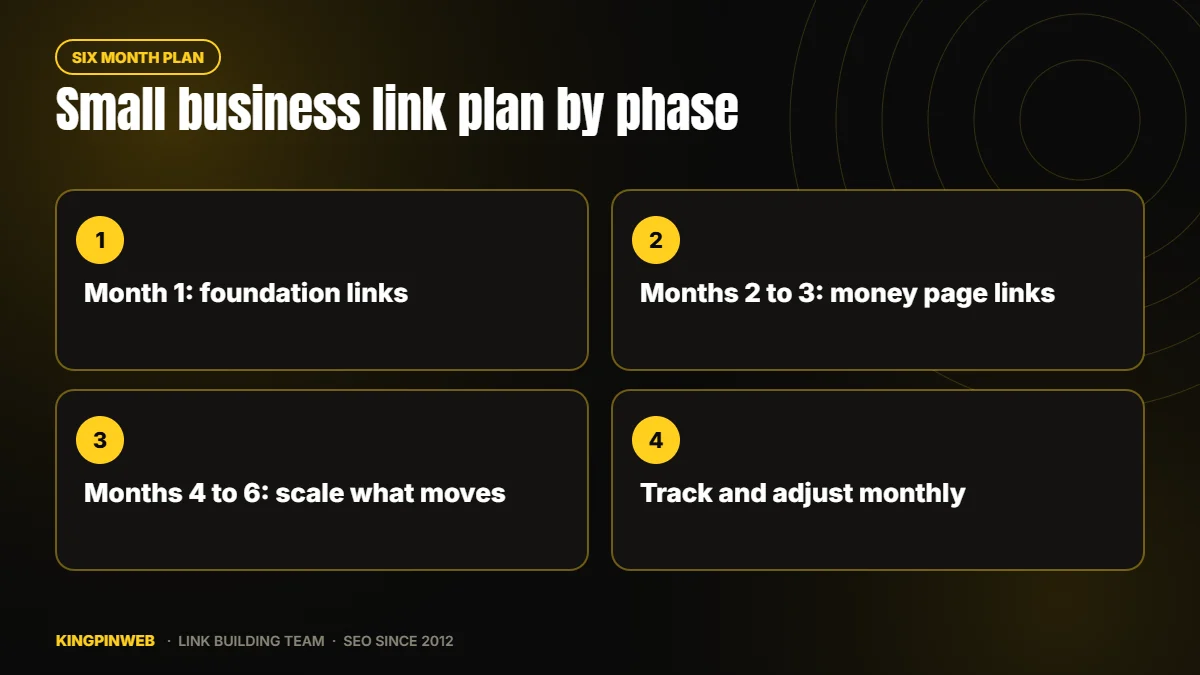
Here is how we sequence the work. The order matters because each phase prepares the site for the next.
Month 1: foundation
New or under linked sites look odd when they suddenly get powerful links and nothing else. A foundation layer of profile, forum, Web 2.0, bookmarking and document links creates a natural, mixed link profile with a blend of dofollow and nofollow links.
Our update-proof foundation backlinks package gives you 230 manually built links of this kind, and it costs far less than a single strong placement. It will not rank a competitive page on its own, but it makes the stronger links that follow look natural.
Months 2 and 3: money page links
Now start pointing contextual links at your chosen pages. For most small businesses we suggest a mix of:
- PBN links for direct ranking power. Our network of 10,000+ sites is built on aged domains with real backlink history.
- Niche edits inside existing articles on real sites with traffic, which add trust and relevance.
- Guest posts where you want a brand mention in front of real readers.
Spread links over several weeks rather than all on one day. Anchor text should be mostly your brand name, the URL and natural phrases, with only a few exact match keywords.
Months 4 to 6: double down on what moves
By month four, you will usually see some pages climbing and others flat. Move more budget to pages sitting on page two or low page one, because they are closest to a breakthrough. Pages that have not moved may need content work before more links.
This is also the point to consider monthly rental homepage links if one page is close to the top three. A homepage link on a strong PBN site passes more weight than an inner page link, and renting means you can keep it only as long as it earns its place.
How to split a small budget
There is no single right number, but here is how we would typically weigh spending at three levels. Treat these as starting points, not fixed rules.
| Monthly budget | Suggested focus | Number of target pages |
|---|---|---|
| Under $300 | Foundation once, then one PBN package per month | 1 |
| $300 to $800 | PBN links plus a niche edit or guest post each month | 2 |
| $800 and up | Mixed PBN, niche edits and guest posts, or monthly rental homepage links | 3 or more |
The common thread: concentrate. A small budget spread across ten pages moves none of them. The same budget on one or two pages often moves both.
Where small businesses waste link money
We see the same mistakes again and again when owners come to us after trying it alone:
- Pointing everything at the homepage. The homepage usually ranks for your brand already. Service and product pages need the help.
- Chasing metrics instead of links. Buying links because a site has a high third party score, without checking real backlinks, age and indexing. We judge sites on those real signals.
- Starting and stopping. One month of links, then nothing for six months. Rankings slip back.
- Cheap bulk packages. Thousands of auto generated links that do nothing, or worse.
- Ignoring the page itself. Links cannot fix a page that does not answer the search. Make sure the content is solid first.
Doing it yourself versus outsourcing
You can build links yourself. Be honest about what it takes: finding sites, pitching editors, writing articles, waiting weeks for replies, checking that links stay live, and learning which sites are worth anything. Owners who try usually spend many hours a month for a handful of placements.
Outsourcing turns that into a simple order. You send target URLs and anchor texts, we handle the sites and handwritten content, and you get an Excel report. If you run an agency with many small business clients, our white label link building delivers the same work under your brand.
Measuring whether your link building strategy works
Check rankings for each target page weekly, but judge results monthly. Daily movements are noise.
Look for these signs in the first three months: pages moving from page three or four onto page two, new long tail keywords appearing in Search Console, and more impressions for your target pages. Calls and sales usually follow once pages reach the top five. Most sites see meaningful movement in one to three months, though competitive local and national terms take longer. We do not guarantee rankings, and anyone who does is overselling.
FAQ
Should a brand new website build links right away?
Yes, but start slowly with foundation links and a few contextual ones while the content settles. A brand new domain can take longer to respond than an older one, so patience matters most in the first months.
Do local businesses need links from local sites?
Local links from chambers of commerce, sponsorships and local news help with local trust, and are worth getting when available. Ranking power for competitive terms still comes mostly from strong, relevant contextual links.
What if a competitor builds more links than us?
Focus on the specific pages where you can win rather than trying to match their total link count. Concentrated links on a strong page often beat a larger but scattered link profile.
Ready to put your link budget to work?
Pick your money pages, then let us do the heavy lifting. Browse all our link building services to choose a starting package, or chat with our team if you want a custom plan for your budget.
About the author

KINGPINWEB Team
KINGPINWEB is an SEO and link building company based in Chennai, India. Since 2012 our in-house team has helped site owners, agencies and businesses rank higher in search. Everything we publish here comes from hands-on work: campaigns we run, rankings we track every day and tests we carry out ourselves. We write these guides to share what works in practice. Our team is led by co-founders Issac M. Paul and Balaji Ragupathi.