Key takeaways
- Google still uses links as one of its strongest signals for deciding which pages deserve to rank.
- Google backlinks are judged on trust, context and pattern, not on raw link counts.
- Spam systems mostly ignore bad links rather than punish them, but manipulative patterns can still lead to manual actions.
- Search Console’s Links report shows a sample of the links Google has found to your site, for free.
- Links from Google’s own properties (Sites, Maps, YouTube) are mostly nofollow and add little ranking power on their own.
Google backlinks are simply the links pointing to your site as Google sees and scores them. Google crawls the web, records every link it finds, and then decides how much each one should count. Some pass real ranking value. Many are discounted or ignored.
Understanding how that judgment works is the difference between building links that move rankings and paying for links Google quietly throws away. Here is how Google treats backlinks in practice, based on what we see across the campaigns we run every day.
Are backlinks still important to Google?
Yes. Google has said for years that links remain one of the main ways it discovers pages and judges their importance. Content quality, relevance and user signals matter too, but in competitive searches the pages at the top almost always have stronger link profiles than the pages below them.
What has changed is how links are scored. Google no longer rewards volume. It rewards links that look earned, sit in real content and come from sites it already trusts. For the bigger picture, see our guide to what backlinks are and how they work.
How Google judges backlinks: the main signals
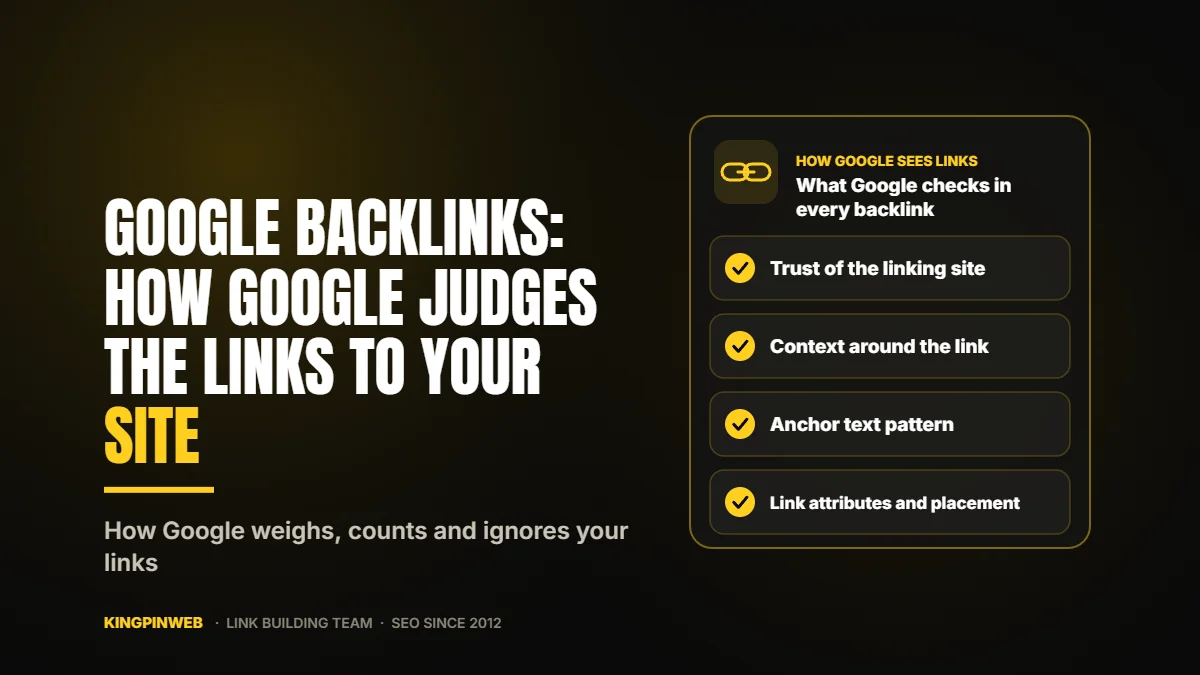
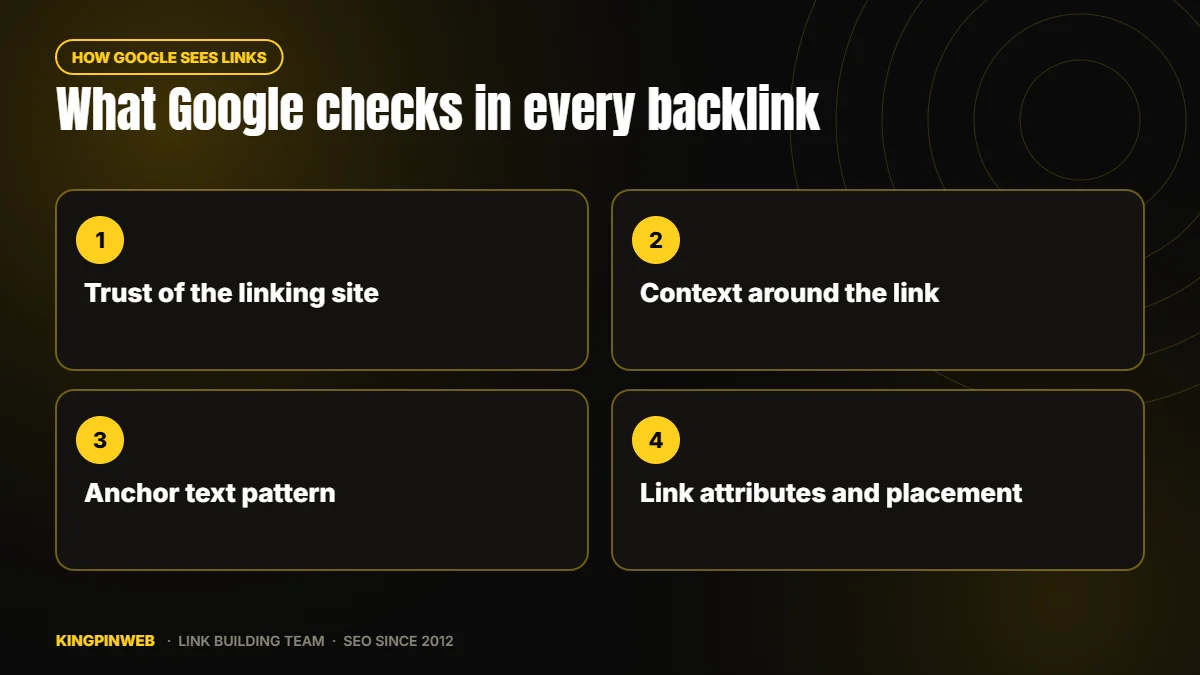
Google does not publish a formula, but its documentation, patents and years of testing point to the same core signals.
Trust of the linking site
PageRank is still at the heart of link scoring. A link from a page that has strong links of its own passes more value than a link from a page nobody links to.
Context and placement
A link inside a relevant paragraph of a real article counts for more than a link in a footer, sidebar or long list of unrelated links. The words around the link help Google understand what your page is about.
Anchor text
Anchor text tells Google what the target page covers. A natural mix of branded, URL, topic and exact match anchors is normal. A profile where most anchors are the same money keyword is a classic warning sign.
Link attributes
Links marked nofollow, sponsored or ugc are treated as hints. Google may use them for discovery, but they usually pass little or no ranking value. Dofollow links in editorial content carry the weight.
Patterns over time
Google looks at your whole profile, not one link at a time. Steady growth from varied sources looks natural. Thousands of links appearing in a week from similar sites does not.
Does the topic of the linking site matter?
Relevance helps, but less than many people think. A link from a site in your exact niche is nice to have, yet a strong, trusted site in a nearby topic often passes more value than a weak site that matches your niche perfectly.
What matters more is that the content around the link makes sense. A plumbing link inside a home improvement article reads naturally. The same link dropped into a casino review does not, and Google can tell the difference.
This is also why we judge domains by their real backlinks, age, clean history and indexing, not by niche labels or a single metric. Strength and a natural fit beat a perfect topic match on a weak site.
Which links Google ignores and which it punishes
Many site owners worry that every weak link will hurt them. In practice, Google’s spam systems mostly neutralize low quality links. They simply stop counting.
| Link type | How Google usually treats it |
|---|---|
| Editorial link in a real article on a trusted site | Counted, can pass strong value |
| Nofollow or sponsored link | Treated as a hint, little ranking value |
| Comment, forum or profile link | Low value on its own, helps diversity |
| Link from auto generated spam pages | Usually ignored |
| Large scale link schemes and obvious networks | Ignored, and in bad cases a manual action |
Manual actions are reserved for clear, large scale manipulation. That is why quality matters so much when you buy links: a well run network with aged domains, separate hosting and handwritten content is built to look and behave like normal websites. Cheap, sloppy networks are the ones that get caught. Our post on whether PBN links still work in 2026 covers this in more depth.
How to check Google backlinks in Search Console
The easiest free way to see your links the way Google records them is Search Console, which is Google’s own report on your site.
- Open Search Console and select your property.
- Click Links in the left menu.
- Review Top linking sites, Top linked pages and Top linking text.
- Use Export external links to download a sample for a closer look.
Keep in mind this is a sample, not every link. New links can take weeks to appear, and Google does not show which links it counts and which it ignores. Third party tools find more links, but their scores are estimates, not Google’s view.
Can you get a backlink from Google itself?
People often search for “backlinks from Google” hoping a link on a Google property will boost rankings. Profiles on Google Sites, Google Maps, YouTube and Google Business Profile do give you links, but most are nofollow and carry little direct ranking power.
They are still worth having. A complete Business Profile helps local rankings, and these profiles add brand signals and a natural base to your link profile. Just do not expect them to push a competitive page to the top.
Building Google SEO backlinks that last
The links that hold up through core and spam updates share a few traits: they sit in real content, on sites with genuine history, with natural anchors, added at a sensible pace. That is the standard we build to.
- PBN links on aged auction domains with real backlink history, each in a handwritten article.
- Guest posts and niche edits on real sites with organic traffic.
- Foundation links to give your profile a natural base.
You can see every option in our link building services. If you are planning a full campaign, our link building strategy guide shows how to combine these link types in a sensible order.
FAQ
Does Google penalize you for links you did not build?
Rarely. Google says its systems are good at ignoring random spam links, so most sites never need to act on them. A disavow file is only worth using if you have a manual action or a known history of paid link schemes.
How long does Google take to count a new backlink?
Google has to crawl the linking page first, which can take a few days to several weeks. Ranking effects usually build over the following one to three months.
Does Google treat links in images differently?
Image links are counted, and the image alt text works like anchor text. A text link in a paragraph still gives Google clearer context.
Want links Google takes seriously?
We have been building links since 2012 across a network of 10,000+ PBNs and real outreach sites, with every placement checked before it goes live. Browse our backlink packages to get started, or contact our team for a custom plan.
About the author

KINGPINWEB Team
KINGPINWEB is an SEO and link building company based in Chennai, India. Since 2012 our in-house team has helped site owners, agencies and businesses rank higher in search. Everything we publish here comes from hands-on work: campaigns we run, rankings we track every day and tests we carry out ourselves. We write these guides to share what works in practice. Our team is led by co-founders Issac M. Paul and Balaji Ragupathi.
Related reading
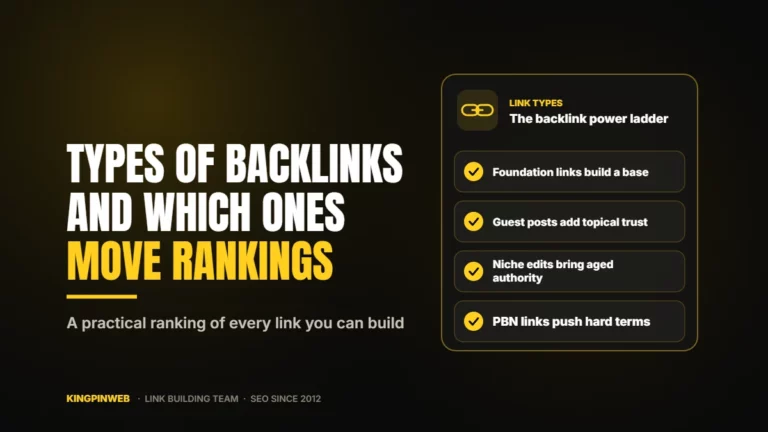 Types of Backlinks and Which Ones Move RankingsRead article
 Backlink Exchange: Why Link Swaps Can Hurt Your SiteRead article
 YouTube Backlinks: Do They Help Your Videos Rank?Read article
 Edu Backlinks and Gov Backlinks: Are They Worth Chasing?Read article
 Link Building for Beginners: Where to StartRead article
 Authority Backlinks: What Makes a Link PowerfulRead article
 A Link Building Strategy for Small BusinessesRead article
 How to Get Backlinks: Ways That Still Work in 2027Read article
 What Are Backlinks? How They Work and Why They MatterRead article