Key takeaways
- Edu backlinks come from sites on .edu domains (mostly US colleges), and gov backlinks from .gov government sites.
- Google does not give a bonus for the domain extension; a link counts because of the page’s own trust and context.
- Real edu and gov links can be strong, but they take months of relationship work and are rarely available on demand.
- Free edu backlink lists point to comment spam, open wikis and abandoned student pages that Google ignores.
- For most sites, strong links from trusted commercial sites move rankings faster and more predictably.
Edu backlinks are links from websites on .edu domains, which in practice means accredited colleges and universities, mostly in the US. Gov backlinks come from .gov sites run by government bodies. Both have a reputation as the most powerful links you can get.
That reputation is half right. A genuine link from a well known university page can be very strong. But the .edu extension itself gives no special boost, and most of the edu and gov backlinks sold or listed online are worthless. Here is what these links are really worth, and when they deserve your time.
Why edu and gov backlinks got their reputation
Universities and government sites tend to be old, heavily linked and carefully maintained. Thousands of other sites link to them, so their pages build up a lot of trust. A link from one of those pages passes some of that trust to you.
Over time, SEOs started crediting the extension instead of the page. The idea spread that any link on a .edu domain was gold. Google has said more than once that it does not treat .edu or .gov links differently because of the domain ending. They are scored like any other link: by the strength and context of the page they sit on.
If you want the basics of how links are scored, our complete guide to backlinks covers it step by step.
Are edu backlinks good for SEO?
A real editorial link from a trusted university page is good, sometimes very good. A link from a forgotten corner of a .edu domain is not.
Large universities host thousands of pages: student blogs, club sites, old course pages, open wikis and event calendars. Many of these have no links of their own, are rarely crawled and are full of spam. A link there passes almost nothing, whatever the domain says.
The same goes for gov backlinks. A mention on a city council’s business resources page can help a local company. A spam comment on an unmoderated government forum will not.
The problem with free edu backlinks and edu backlink lists
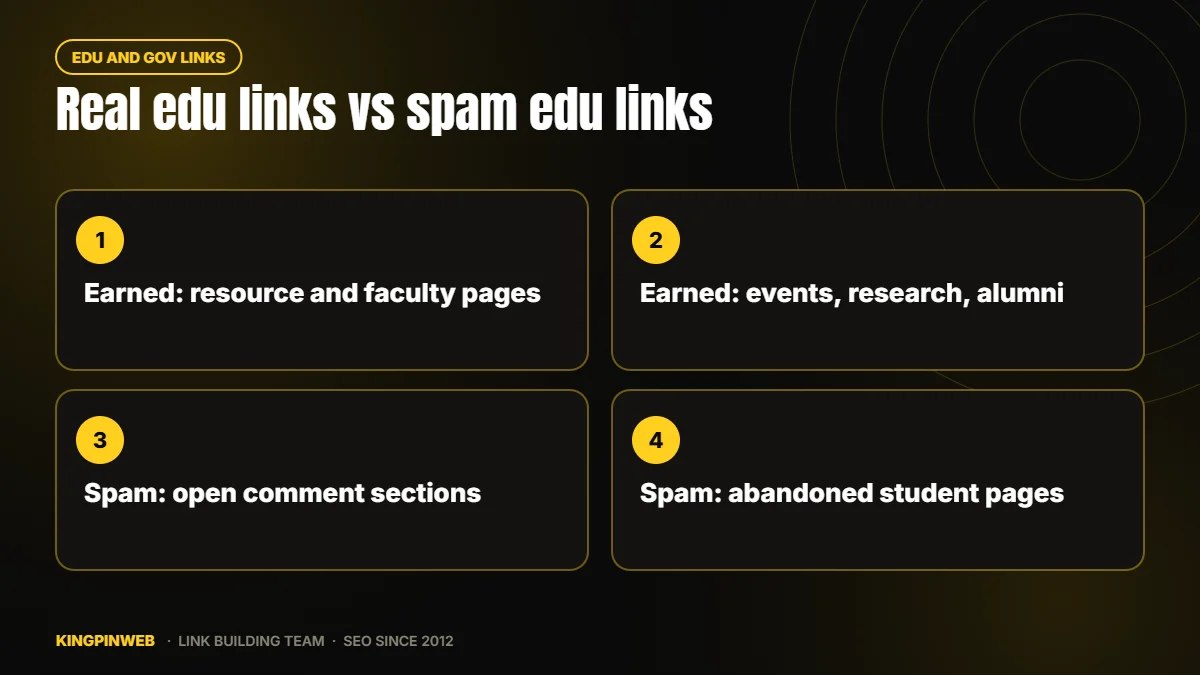
Search for “free edu backlinks” or an “edu backlink list” and you will find pages promising hundreds of .edu links in an afternoon. Nearly all of them point to the same places:
- Open blog comment sections on university blogs that nobody moderates.
- Student or staff profile pages on forums and learning platforms where anyone can sign up.
- Abandoned wikis and old course pages already buried in spam links.
- Hacked pages where spammers have injected links without the school knowing.
Google’s spam systems recognize these patterns easily and ignore the links. In the worst cases, a profile full of hacked page links and comment spam looks like a link scheme. Packages selling “10 edu backlinks” for a few dollars almost always come from these sources.
How to spot a worthless edu or gov link
If someone offers you .edu links, or you find one in your own profile, a few quick checks tell you whether it has any value:
- Look at the page, not the domain. Is it a real, maintained page, or a profile, comment or forgotten wiki entry?
- Check that the page is indexed. Search for the exact URL in Google. If it does not show, the link passes nothing.
- Count the other outbound links. A page with hundreds of unrelated links is a spam dump.
- Read the context. A link to a payday loan site in a chemistry department blog comment is an obvious red flag.
- Check whether the school knows about it. Links injected into hidden parts of a page are a sign of hacking.
If a link fails two or more of these checks, treat it as worthless and do not pay for more of the same.
How real edu and gov backlinks are earned
Genuine links from colleges and agencies do exist. They are earned through work that benefits the institution, and they take time.
| Route | Typical time | Realistic outcome |
|---|---|---|
| Resource pages for students or faculty | 2 to 6 months of outreach | A few links if your content is truly useful |
| Expert input for research or courses | 3 to 12 months | Occasional citations, hard to plan |
| Campus events, jobs and internships | 1 to 4 months | Links from career or event pages |
| Local government business listings | Weeks, if you qualify | One or two relevant local links |
| Scholarships | Months, plus prize money | Overused, many schools no longer link |
None of these are quick. University staff are busy, many schools have strict linking policies, and scholarship pages in particular have been so heavily abused that many financial aid offices removed outside links altogether.
Edu and gov backlinks for SEO: where they fit
If you happen to have a natural reason to earn one, take it. A relevant university or agency link adds trust and diversity to any profile.
But chasing them as the main part of a campaign rarely makes sense. The time spent on a single genuine edu link could fund many strong placements on trusted commercial sites. And because the domain ending gives no bonus, those commercial links often pass just as much value.
What matters is the same set of signals every time: real referring domains, age, clean history, indexed pages and a link that sits naturally in content. Plenty of non edu sites meet that bar.
Better uses of your link building budget
Instead of chasing hard to get .edu links, most of our clients get faster results from links they can actually plan around:
- Guest posts and niche edits on real sites with organic traffic and strong link profiles.
- PBN links on aged auction domains with real backlink history, such as our strongest PBN links on Moz DA 50+ sites.
- Foundation links to give your profile a broad, natural base.
You can compare every option on our services page. If you are just starting out, our link building for beginners guide explains which links to build first.
FAQ
Can anyone register a .edu domain?
No. In the US, .edu domains are limited to accredited post secondary institutions, which is why they are hard to fake. Many countries use other endings for schools, such as .ac.uk or .edu.au.
Do edu links from other countries count the same?
They are scored the same way as any link, by the strength and context of the page. A strong page on .ac.uk is just as useful as a strong page on .edu.
Is it worth paying for .edu links?
Be careful. Real editorial edu links are rarely for sale, so most paid edu packages use comment spam or hacked pages. Spend that money on vetted placements you can actually check instead.
Ready for links that move rankings?
We have been building links since 2012 on a network of 10,000+ PBNs and real outreach sites, all vetted by hand. See our link building packages to choose a plan, or contact our team for a custom mix.
About the author

KINGPINWEB Team
KINGPINWEB is an SEO and link building company based in Chennai, India. Since 2012 our in-house team has helped site owners, agencies and businesses rank higher in search. Everything we publish here comes from hands-on work: campaigns we run, rankings we track every day and tests we carry out ourselves. We write these guides to share what works in practice. Our team is led by co-founders Issac M. Paul and Balaji Ragupathi.
Related reading
 Types of Backlinks and Which Ones Move RankingsRead article
 Backlink Exchange: Why Link Swaps Can Hurt Your SiteRead article
 YouTube Backlinks: Do They Help Your Videos Rank?Read article
 Link Building for Beginners: Where to StartRead article
 Google Backlinks: How Google Judges the Links to Your SiteRead article
 Authority Backlinks: What Makes a Link PowerfulRead article
 A Link Building Strategy for Small BusinessesRead article
 How to Get Backlinks: Ways That Still Work in 2027Read article
 What Are Backlinks? How They Work and Why They MatterRead article