
Key takeaways
- Link building for beginners starts with fixing your target pages, not buying links.
- Build in order: foundation links first, then contextual links, then power links to money pages.
- Judge how many links you need by looking at the pages already ranking, not keyword difficulty scores.
- Keep anchors varied, with brand and URL anchors making up a large share.
- Most sites see movement in one to three months with a steady pace.
Link building for beginners comes down to one idea: other websites linking to yours tell search engines your pages deserve attention. The more trusted and relevant those links are, the easier it becomes to rank for the searches your customers type.
The hard part is not the idea. It is knowing which links to get first, how many, how fast and what to avoid. We have been building links for clients since 2012, and this guide lays out the path we would give any site owner starting from zero.
If you already know you want help, you can browse our link building services and come back to this guide as a reference.
For the basics first, read our complete guide to backlinks.
What a backlink actually does for a new site
A backlink is a clickable link on another website that points to a page on yours. Search engines treat it as a signal that your page is worth finding.
Not every link counts the same. A link from an aged site with its own strong backlinks passes far more value than a link from a brand new blog nobody links to. Placement matters too: a link inside a real article carries more weight than one buried in a footer.
For a new site, links do three jobs:
- Discovery: they help search engines find and crawl your pages faster.
- Authority: they build the overall strength of your domain over time.
- Relevance: the words around the link and the anchor text tell search engines what your page is about.
The main link types, explained simply
Beginners often hear a dozen terms at once. In practice, almost every campaign we run uses some mix of the link types below.
| Link type | What it is | Best used for |
|---|---|---|
| Foundation links | Profiles, forums, Web 2.0 pages, bookmarks and similar | A natural base and anchor diversity for a new site |
| Guest posts | A new article on a real site with traffic, carrying your link | Steady authority and relevant context |
| Niche edits | Your link added to an existing, indexed article | Faster pickup, since the page already has age |
| PBN links | Links from sites built on aged expired domains with real backlink history | Strong ranking power for money pages |
You do not need all four on day one. The order you add them in matters more than the variety.
Where to start: link building for beginners in five steps
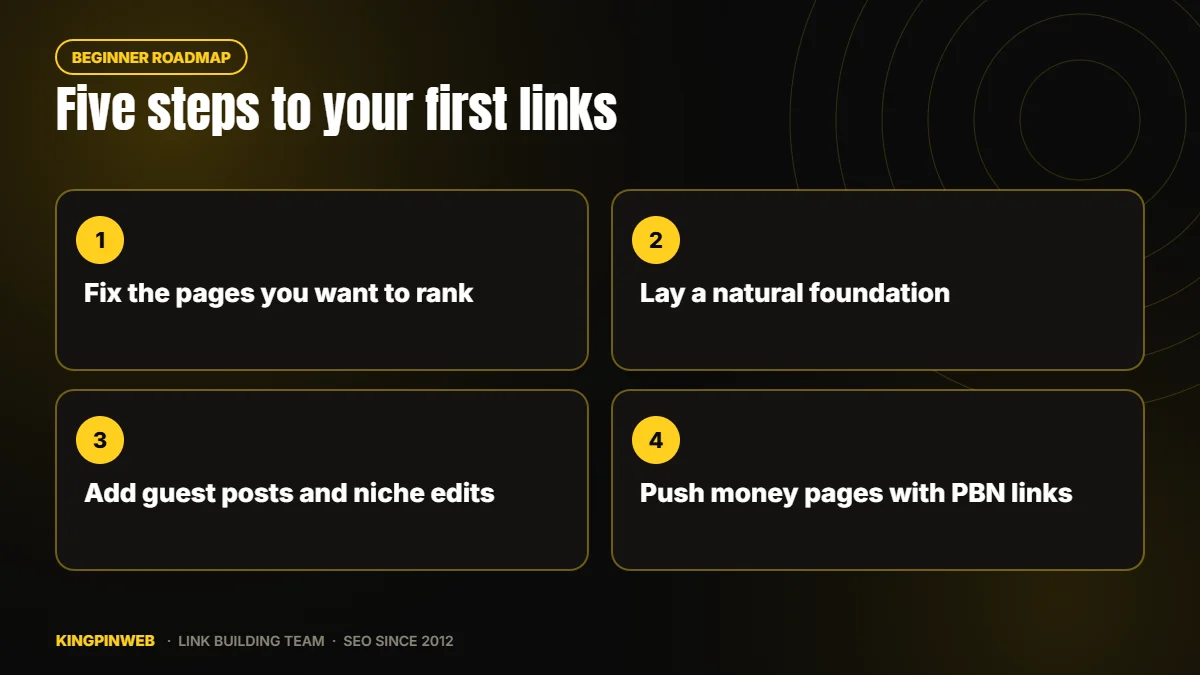
Here is the order we recommend for a site that has little or no link history.
- Fix the pages you want to rank. Links amplify what is already there. A thin page with a strong link still struggles. Make sure each target page answers the search properly.
- Lay a natural base. Start with a varied set of foundation links so your profile looks like a real business that has been noticed around the web, with brand and URL anchors.
- Add contextual links from real sites. Guest posts and niche edits bring relevant, in-content links that build trust steadily.
- Push your key pages with power links. Once the base is in place, quality PBN links aimed at your main money pages are what usually move a page from page two to page one.
- Track, wait and repeat. Watch rankings weekly, give links time to settle and build the next round where the gaps are.
This sequence keeps your profile looking natural while still putting real force behind the pages that make you money.
How many links does a beginner need?
There is no fixed number, and anyone who quotes one without looking at your market is guessing. The honest answer is: enough to match or beat the pages already ranking for your keyword.
A practical way to judge it is to look at the top five results for your main keyword and note roughly how many referring domains each ranking page has. If they sit at 20 to 40, you know the scale of work. If they sit in the hundreds, you are in a tougher market and should plan for a longer campaign.
Keyword difficulty scores in SEO tools are a poor shortcut here. We have seen “hard” keywords move quickly and “easy” ones stall. Looking at the real competing pages tells you far more.
Anchor text basics every beginner should know
Anchor text is the clickable wording of a link. It is one of the easiest things to get wrong.
- Brand anchors use your business name. These should make up a large share of a new profile.
- URL anchors use your web address. They look natural and are safe in volume.
- Partial match anchors include part of your keyword inside a longer phrase.
- Exact match anchors are your target keyword word for word. They are powerful, but should be used sparingly.
The common beginner mistake is pointing every link at the homepage with the exact keyword. That pattern looks unnatural. Spread anchors out and spread links across several pages. Our guide to anchor text for PBN links goes deeper on the ratios we use.
Beginner mistakes that waste money
Most failed first campaigns we review share the same few problems.
Chasing metrics instead of real strength
A site can show a high score in a tool while having almost no real backlinks behind it. Metrics like Spam Score, Trust Flow and Citation Flow are weak guides. We judge a site by its actual backlinks, its age, a clean history and whether its pages get indexed.
Buying the cheapest links available
Very cheap links usually come from thin networks with spun content, shared hosting and obvious footprints. They rarely move rankings and they are where most of the risk people talk about comes from.
Building too much, too fast, then stopping
A sudden spike followed by nothing looks odd. A steady pace over several months looks like a business that keeps earning attention.
Judging results after one week
Links need to be crawled, indexed and counted. Most sites see movement in one to three months, sometimes sooner on less competitive keywords.
Doing it yourself versus ordering links
You can try to earn links yourself through outreach, but it helps to know what that involves. Outreach means finding hundreds of sites, pitching editors, writing articles to their standards and following up for weeks. Reply rates are low and the hours add up fast.
Building your own network of sites is even heavier. It means buying aged domains, hosting each one separately, writing content and maintaining it all for years. That is why most site owners and agencies hand this work to a team that already has the sites, the writers and the process.
When you order from us, you send your target URLs and anchors on the order form, we place links inside handwritten articles and you receive an Excel report. Reports are unbranded, which is why many agencies resell our work.
A sensible first budget
For a small local or niche site, a realistic first month often looks like this:
- One foundation package to set a natural base.
- A few guest posts or niche edits on relevant pages.
- A starter PBN package aimed at your two or three most important pages.
Our foundation backlinks package is $62, and PBN packages start at $170. That puts a solid first round within reach of most small businesses, and you can scale once you see which pages respond.
FAQ
Should a brand new domain wait before building links?
You do not need to wait months, but start gently. A few weeks of foundation links before stronger links is a sensible pace for a fresh domain.
Do nofollow links have any value for beginners?
Yes. A natural profile always contains a share of nofollow links, and they still bring crawling and some referral traffic. A profile with only dofollow links looks manufactured.
Can links fix a site with technical problems?
Not fully. If pages are blocked from indexing or load very slowly, links cannot make up for that. Fix the basics first so the links can do their job.
Is it fine to build links to inner pages, not just the homepage?
It is better. Service pages, product pages and guides are what rank for specific searches, so they should receive a good share of your links.
Ready to take the first step?
Link building is easier when someone has already done it thousands of times. Pick a starting package from the KINGPINWEB shop, or talk to our team if you want help choosing the right mix for your site.
About the author

KINGPINWEB Team
KINGPINWEB is an SEO and link building company based in Chennai, India. Since 2012 our in-house team has helped site owners, agencies and businesses rank higher in search. Everything we publish here comes from hands-on work: campaigns we run, rankings we track every day and tests we carry out ourselves. We write these guides to share what works in practice. Our team is led by co-founders Issac M. Paul and Balaji Ragupathi.
Related reading
 Types of Backlinks and Which Ones Move RankingsRead article
 Backlink Exchange: Why Link Swaps Can Hurt Your SiteRead article
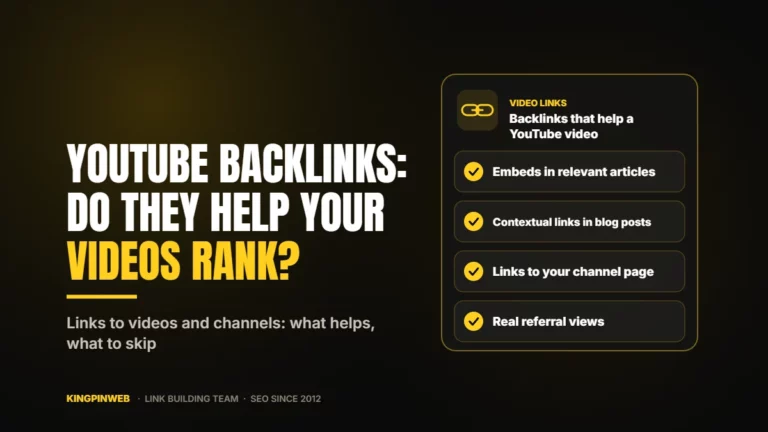 YouTube Backlinks: Do They Help Your Videos Rank?Read article
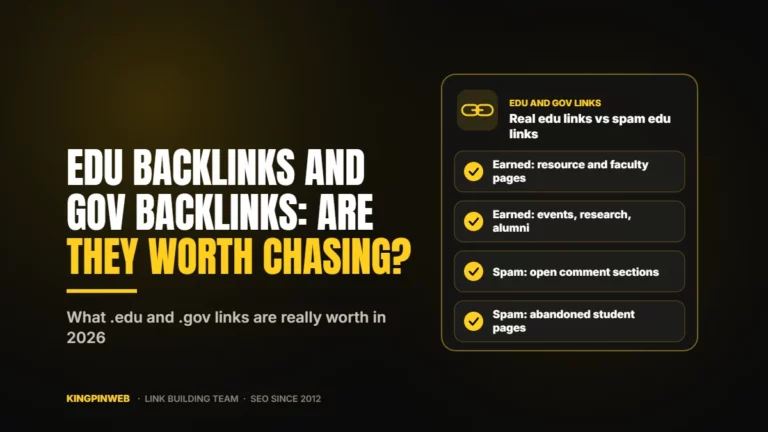 Edu Backlinks and Gov Backlinks: Are They Worth Chasing?Read article
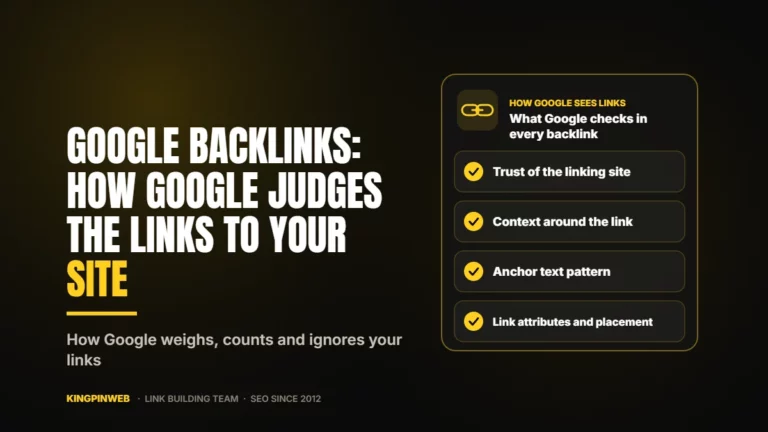 Google Backlinks: How Google Judges the Links to Your SiteRead article
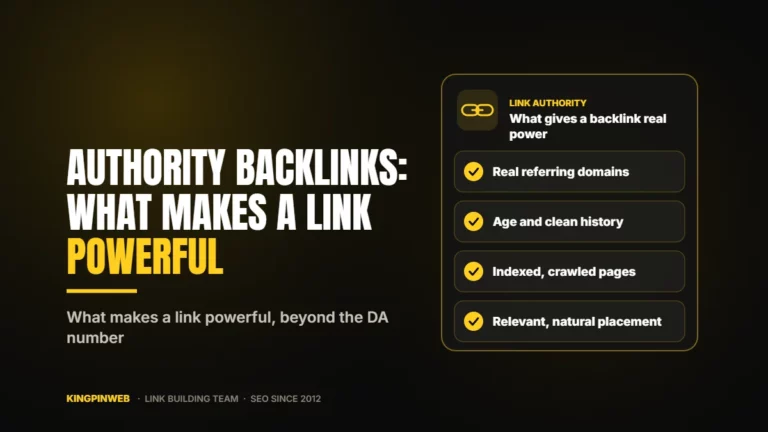 Authority Backlinks: What Makes a Link PowerfulRead article
 A Link Building Strategy for Small BusinessesRead article
 How to Get Backlinks: Ways That Still Work in 2027Read article
 What Are Backlinks? How They Work and Why They MatterRead article