Key takeaways
- Personal injury is the most link driven legal niche because case values let firms outspend each other.
- Top ranking firms have links pointing at each practice page, not just the homepage.
- Directories are a floor; contextual and PBN links are what push pages into the top three.
- Keep exact match anchors to a small share and spread variations across each page.
- Most firms see movement in one to three months, with big metros taking longer.
Personal injury lawyer SEO is the hardest fight in legal search. A single signed car accident case can be worth more than a year of marketing spend, so every firm in your city is chasing the same handful of keywords, and most of them already have good websites.
When content and on page work are equal, links decide the winner. That is why we treat personal injury as a link building problem first. Our link building service for law firms is built around exactly this kind of crowded market.
Below we break down what the top PI firms are doing, where most firms waste money, and how a realistic link plan looks month by month.
Why personal injury lawyer SEO is different from other legal niches
A family law or estate planning firm in a mid sized city may rank with a decent site and a few local citations. Personal injury does not work that way.
- Case value is high. Firms can afford to outspend each other for years, so the top three spots are defended hard.
- National brands compete locally. Large injury firms and lead generation sites build city pages for every metro.
- Search intent is urgent. Someone searching “truck accident lawyer near me” calls within minutes, so the map pack and the first organic results take almost every click.
- Keywords multiply. Car, truck, motorcycle, slip and fall, dog bite, wrongful death, each with city and neighborhood variations.
Each of those keyword groups needs its own page, and each page needs authority pointing at it. That is where most PI firms fall behind.
What the firms on page one usually have in common
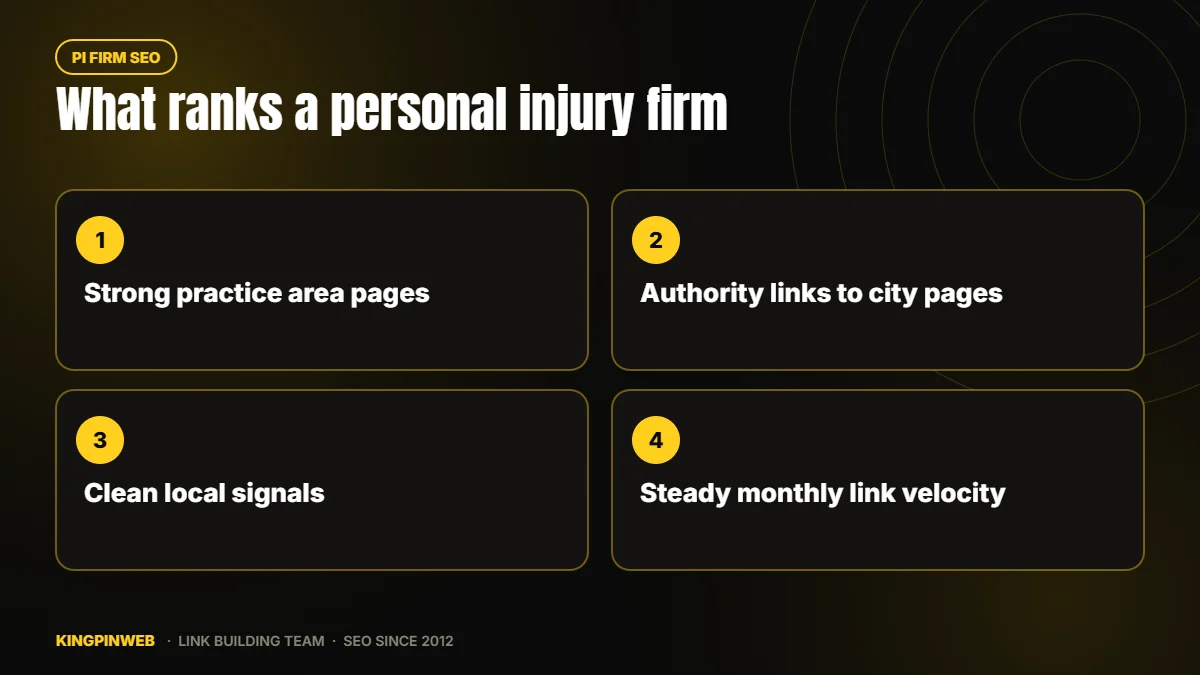
When we audit the top results for an injury keyword in any US city, the pattern is consistent. Content quality is close across the board. The gap shows up in the backlink profile.
| Signal | Firms stuck on page two | Firms in the top three |
|---|---|---|
| Links to the homepage | Mostly directories and citations | Directories plus strong contextual links |
| Links to practice area pages | Few or none | Steady links to each money page |
| Anchor text | Brand name only | Brand, URL, partial match and natural phrases |
| Link growth | Bursts, then nothing | New links every month |
The second row matters most. A firm can have a strong homepage and still lose “motorcycle accident lawyer Houston” because that practice page has no authority of its own.
Where personal injury firms waste their link budget
We see the same mistakes from firms that come to us after a year with another vendor.
Buying only legal directories
Directories and bar listings help with trust and local signals, but every competitor has the same ones. They are a floor, not a ladder.
Chasing metrics instead of real authority
A site with a high Trust Flow or a low Moz Spam Score is not automatically a good link. We judge a linking site by its real backlinks, its age, its clean history and whether its pages are indexed. Those are the things that actually pass value.
Pointing everything at the homepage
The homepage is rarely the page that should rank for “car accident attorney” in a specific city. Links need to go where the money keywords live.
Stopping after one push
Injury rankings are defended every month. A firm that builds twenty links in January and nothing after usually slides back by summer.
The link mix we use for injury law firms
No single link type wins a PI market on its own. We combine several so the profile looks natural and the authority lands where it is needed.
- Foundation layer. A broad base of profiles, Web 2.0 properties and bookmarks gives the domain a natural spread of dofollow and nofollow links. Our update-proof foundation package handles this in one order.
- Contextual links on real sites. Guest posts and niche edits on sites with real traffic give topical trust to practice pages.
- PBN power for the hardest terms. For the most contested city keywords, links from our network of 10,000+ PBN sites built on aged auction domains add the authority that pushes a page from position eight into the top three.
- Ongoing monthly links. A steady flow keeps rankings defended once they are earned.
The ratio changes by market. A firm in a smaller metro may need mostly contextual links. A firm fighting in Los Angeles, Houston or Atlanta usually needs the heavier authority as well.
Anchor text for personal injury pages
Injury keywords are tempting to stuff into anchors because they are so valuable. That is how firms trip filters.
We keep exact match anchors to a small share of links for each page. Most anchors use the firm name, the URL, partial phrases like “injury attorneys in Dallas” and natural wording such as “this firm” or “their team”. We go deeper on this in our guide to anchor text planning.
When a page has several keyword variations, we spread the anchors across them rather than repeating one phrase. That gives Google a clearer picture of everything the page is about.
A realistic timeline for PI rankings
We do not guarantee rankings, and anyone who does in this niche is not being straight with you. What we can share is what we usually see.
- Weeks 1 to 4: links are placed and start getting indexed. Rankings may move slightly.
- Months 1 to 3: most practice pages see clear movement, often from page three or four onto page two or the bottom of page one.
- Months 3 to 6: in competitive metros, the push into the top three usually takes continued links and patience.
Smaller cities move faster. A firm targeting a county seat can often see top results well before a firm targeting a major metro.
Running PI link building in house versus outsourcing it
Some firms try to handle links with a marketing coordinator. The work involves finding sites, vetting their backlink history, writing articles that read naturally, negotiating placements and tracking every link. That is a full time job, and mistakes in this niche cost real rankings.
Our team has done this since 2012. Firms and legal marketing agencies order through our client portal, send target URLs and anchors on the order form, and receive an Excel report. Reports carry no KINGPINWEB name or logo, so agencies can pass them straight to their law firm clients.
FAQ
Does a personal injury firm need a separate page for each city?
If you take cases in several cities, yes. Each city page needs unique content about local courts, roads and accident types, and each page needs its own links to rank.
Can links help a firm get into the Google map pack?
Links to your website strengthen the domain that your business profile points to, which supports map rankings. Reviews, proximity and a complete profile still matter alongside them.
Will opposing counsel or the bar see the links?
The links sit on independent sites inside normal articles, so they look like any other mention. We do not share PBN live URLs publicly, which keeps the network private.
Is personal injury lawyer SEO worth it for a solo practitioner?
Often more so than for big firms, because one or two extra signed cases a month covers the cost many times over. A solo firm should start with its strongest practice area and one city.
Ready to win more injury cases from search?
If your firm is stuck behind competitors with stronger link profiles, we can close that gap. See how our law firm link building plans work, or contact our team with your target cities and practice areas for a custom plan.
About the author

KINGPINWEB Team
KINGPINWEB is an SEO and link building company based in Chennai, India. Since 2012 our in-house team has helped site owners, agencies and businesses rank higher in search. Everything we publish here comes from hands-on work: campaigns we run, rankings we track every day and tests we carry out ourselves. We write these guides to share what works in practice. Our team is led by co-founders Issac M. Paul and Balaji Ragupathi.