
Key takeaways
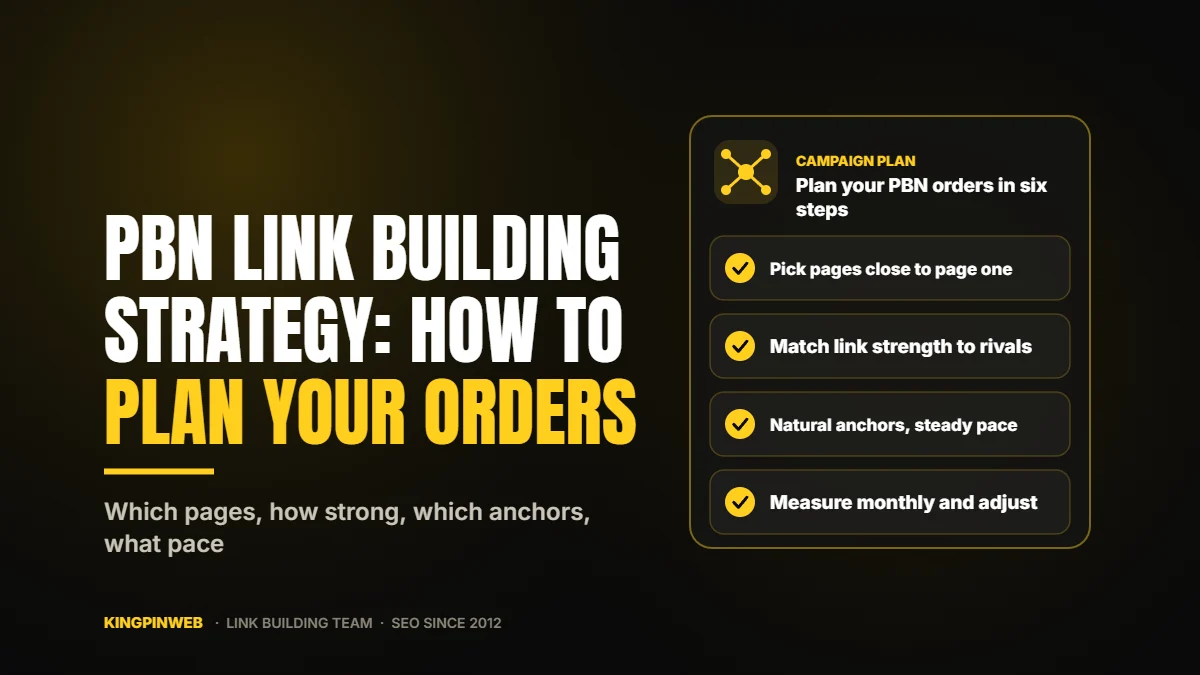
- A good PBN link building strategy decides which pages get links, how strong, with which anchors and at what pace.
- Start with pages already close to page one; they usually return the most for each link.
- Match link strength to competition: standard links for most pages, the strongest tier for money keywords.
- Keep anchors natural and spread orders over weeks, alongside foundation links, niche edits and guest posts.
- Review results monthly and put the next order where the data says it will count.
A PBN link building strategy is a plan for where your links go, how strong they are, which anchors they use and how fast you add them. The links themselves can be excellent, but without a plan they get spread thinly, pointed at the wrong pages or added in bursts that look unnatural.
We have planned link campaigns since 2012 for site owners, agencies and our own projects, using a network of 10,000+ PBN sites. Below is the approach we use to plan orders, step by step, so every link has a job, whether you order our POWERFUL PBN Links That Work or a mix of services. If you need the basics first, read our complete guide to PBN links.
Why you need a PBN strategy before you order
Most disappointing PBN campaigns share the same story: a batch of links pointed at the homepage with the main keyword as anchor, then nothing for months. The links were fine. The plan was missing.
A clear PBN strategy answers four questions before money is spent: which pages, how strong, which anchors and what pace. Get those right and even a modest budget can move rankings.
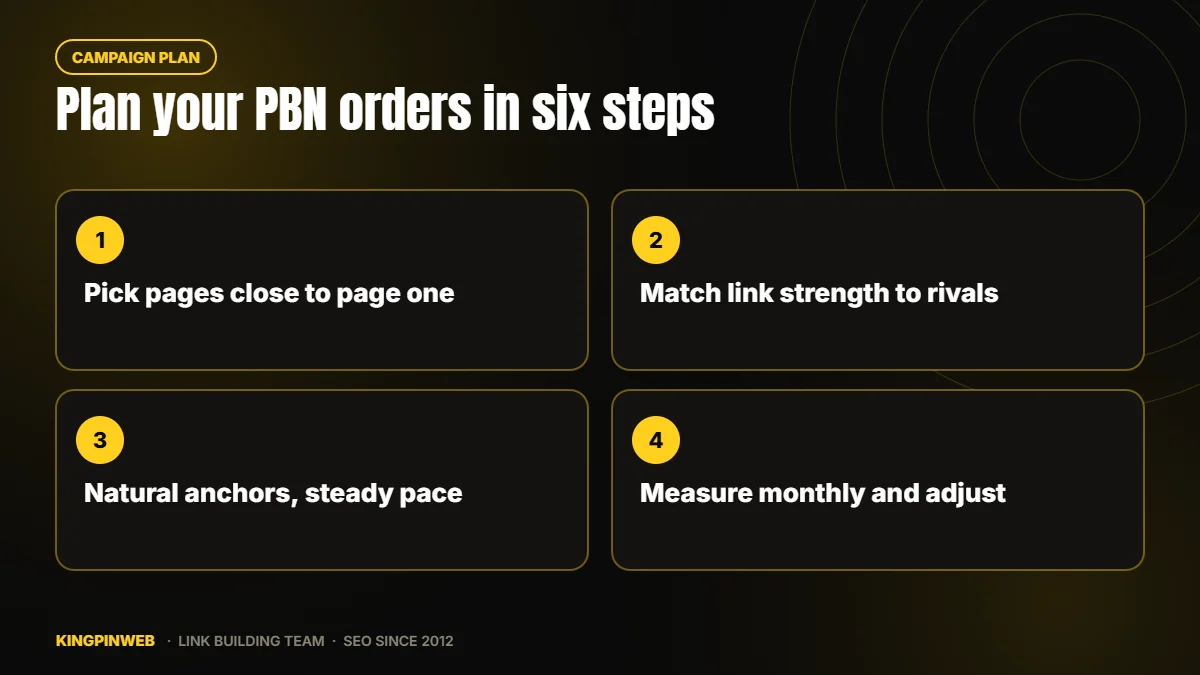
Step 1: pick the pages that will gain the most
Not every page deserves links, and not every page benefits equally. We usually prioritize:
- Pages ranking roughly in positions 8 to 30. They are already trusted for the topic and often need only a push.
- Pages that make money. Service pages, product categories and lead pages, rather than old blog posts nobody converts on.
- Pages with solid content. Links amplify a good page. They cannot fix a thin one, so improve content first where needed.
Pointing everything at the homepage is the most common mistake. Inner pages that match a specific search usually respond faster.
Step 2: match link strength to competition
Look at the pages ranking above you. If they are small local sites, you need less force than if they are national brands with years of links.
| Situation | Suggested link type | Why |
|---|---|---|
| Local or low competition keywords | POWERFUL PBN Links (DA 20+, RD 50+) from $170 | Enough authority for most inner pages |
| National money keywords | Strongest PBN Links (DA 50+, RD 100+) from $350 | More force against strong competitors |
| Toughest keywords, ongoing push | Monthly rental homepage links from $255 a month | Homepage strength, renewed every 30 days |
| New site with no base | Foundation links first ($62) | A natural base before contextual links |
Whether to rent homepage links or buy one time links depends on budget and how long you need the push. We compare both in renting vs buying PBN links.
Step 3: plan your anchor text
Anchors are where many PBN link building strategies go wrong. A profile full of exact match keywords looks manufactured. Plan a mix before you fill in the order form:
- Branded anchors such as your business name.
- Partial match anchors that include your keyword inside a longer phrase.
- Generic and URL anchors like the page address or a natural phrase.
- Exact match anchors used sparingly, and only on the strongest links.
Our PBN anchor text guide covers the ratios we use in practice.
Step 4: set a natural pace
A few links a month to a page looks like a site earning attention. Dozens in a single week looks like a campaign. Spread orders across weeks, and build a page’s links over two or three months rather than in one go.
Pace also helps you learn. When links arrive steadily, you can see what moved a page and adjust the next order, instead of guessing after a single large batch.
Step 5: mix PBN links with other link types
The strongest profiles are not built on one link type. A balanced plan usually combines:
- Foundation links for a broad, natural base.
- Niche edits on aged, indexed articles for trust and relevance.
- Guest posts on real sites for topical depth.
- PBN links for direct ranking power on the pages that matter most.
This mix looks like a real site gaining links from many places, and it spreads value across different signals.
A sample three month plan for one page
Here is how we might plan links for a single service page ranking around position 15 for a competitive local keyword. Your plan will differ with competition and budget.
- Month 1: foundation links plus two PBN links, with branded and generic anchors.
- Month 2: two more PBN links and one niche edit, with partial match and branded anchors.
- Month 3: one strongest tier PBN link with an exact match anchor, then a full review of results.
Most sites see movement in one to three months, though competitive terms can take longer and we do not guarantee rankings.
Step 6: measure and adjust
Review each page monthly, not daily. Look for rising impressions, new long tail keywords and gradual position gains. If a page moves, keep the same pace. If it stalls after two or three months, check content and on page issues first, then consider a stronger tier rather than simply adding more of the same.
Each order delivers an unbranded Excel report, so you can track every link against your rankings. We do not share PBN live URLs publicly, which keeps the network private for every client.
Common PBN link building strategy mistakes
Even with good links, a few planning mistakes hold campaigns back. These are the ones we see most often when new clients show us their past orders:
- Buying on price alone. A pile of cheap links from a poorly kept network adds risk and little value. Fewer links from aged, indexed sites do more.
- Chasing one score. Choosing links by DA alone ignores real backlinks, age, clean history and indexing, which are what actually carry value.
- Changing too much at once. Rewriting a page, moving its URL and adding ten links in the same week makes it impossible to tell what worked.
- Stopping too early. Pages often move in steps over several weeks. Pausing after the first month can waste the work already done.
Avoiding these is mostly a matter of patience and planning, which is exactly what a written plan gives you.
FAQ
Should a PBN link building strategy change for a brand new site?
Yes. New sites need a foundation layer and a slower pace before stronger contextual links, so the profile grows naturally.
How many pages should one campaign target at once?
Fewer than most people think. Focusing on two or three priority pages usually beats spreading the same budget across ten.
Can agencies use the same plan for client sites?
Yes. Many agencies use this approach and resell our links, since reports carry no KINGPINWEB name or logo.
Ready to put your plan into action?
Once you know which pages, anchors and pace you need, order PBN links for your first round and send your URLs and anchors on the form. Want help shaping the plan? Talk to our team on support chat.
About the author

KINGPINWEB Team
KINGPINWEB is an SEO and link building company based in Chennai, India. Since 2012 our in-house team has helped site owners, agencies and businesses rank higher in search. Everything we publish here comes from hands-on work: campaigns we run, rankings we track every day and tests we carry out ourselves. We write these guides to share what works in practice. Our team is led by co-founders Issac M. Paul and Balaji Ragupathi.
Related reading
 How to Build a PBN: Real Costs, Time and RisksRead article
 PBN Management: How We Keep 10,000+ PBNs StrongRead article
 Safe PBN Backlinks: 9 Checks Before You OrderRead article
 Renting vs Buying PBN Links: Which Suits Your SiteRead article
 PBN Domain Authority: Why DA Alone Misleads BuyersRead article
 How to Test a PBN Link: A Buyer’s Checklist From Live to RankingRead article
 12 PBN Myths That Cost SEOs Rankings (And What Is Actually True)Read article
 PBN Anchor Text: How to Choose Anchors for Your Link OrdersRead article
 Do PBN Links Still Work in 2026? Honest Answer + ProofRead article