
Key takeaways
- Learning how to build a PBN is easy; building one that stays strong for years is slow, costly work.
- The four big jobs are domains, hosting, content and upkeep, and each one has hidden costs.
- A small network of 10 sites can cost several thousand dollars up front plus monthly running costs before it moves a single ranking.
- Most risk comes from shortcuts and footprints, not from PBN links as such.
- Most SEOs get the same power faster by renting links from an established network like our 10,000+ PBNs.
If you are researching how to build a PBN, the honest answer is that the idea is simple and the execution is not. You buy aged expired domains with real backlinks, host each one so nothing ties them together, publish real content on them and then place links to your money site.
The hard part is everything around those four steps: finding domains that are actually clean, paying for them, keeping the sites alive and doing it all without leaving a trail. We have been building and running our own network since 2012, so this guide lays out what it really takes, what it costs and where people get burned.
We are not going to give you a step by step DIY manual. We are going to show you the full bill, so you can decide whether to set up a PBN yourself or use one that already exists.
How to build a PBN: what it actually involves
A private blog network is a group of websites you control, each built on a domain that already has authority from its previous life. Their job is to pass that authority to the pages you want to rank. If you want the background first, read our complete guide to PBN links.
To build a PBN network that works, you need to get four things right at the same time:
- Domains with real referring domains, age and a clean history.
- Hosting that makes every site look independently owned.
- Content that makes every site look like a real, living website.
- Upkeep for as long as you want the links to count.
Miss any one of these and the network either stops passing value or becomes easy to spot. That is why the question is less “how to create a PBN” and more “can we keep one healthy for years”.
Step one: sourcing domains (the expensive part)
Everything depends on the domain. A PBN site is only as strong as the backlinks it inherited, so finding PBN domains is where most of the money and most of the mistakes go.
Good domains come from expiring and auction inventory. The trouble is that thousands of people are hunting the same lists, so the clean, strong names get bid up quickly, while the cheap leftovers are cheap for a reason.
Before any domain is worth buying, someone has to check:
- Real referring domains, opened and read by hand, not just counted by a tool.
- History in old snapshots: no spam, no adult or pharma use, no foreign language takeover.
- Anchor text profile: natural brand and URL anchors, not hundreds of spammy keywords.
- Indexing and age: still known to Google, ideally 5 to 25+ years old.
Most domains fail these checks. In our experience you review dozens to find one worth owning. We explain the full vetting process in our guide to expired domains for SEO, and why DA alone is a poor filter in our post on PBN domain authority.
Step two: hosting without footprints
If ten sites share one server, one IP range, one theme and one registrar account, they look like one owner. That pattern is what gets cheap networks found.
So each site needs its own hosting setup, its own IP, varied registrars, different themes and plugins, and no shared analytics or contact details. Spreading sites across providers costs more than putting them all on one cheap plan, and it takes time to manage dozens of logins and invoices.
This is the part people most often cut to save money, and it is the part that matters most for keeping the network private.
Step three: content that makes each site real
A PBN site with three thin posts and a link is easy to read as a link farm. Each site needs a believable topic, an about page, regular posts and a reason to exist.
When you create PBN links, the link should sit inside a handwritten article that makes sense for that site. Spun or AI filler content is cheap, but it lowers the value of the link and makes the site look like what it is.
For a network of 10 to 20 sites, that means a steady flow of articles every month, written to a standard, posted on a schedule that does not repeat across sites.
The real cost and time of building a PBN
Here is a realistic picture for a small network of about 10 sites. Figures are typical ranges we see in the market, not fixed prices.
| Item | Typical cost | Time | Main risk if done cheaply |
|---|---|---|---|
| Vetting and buying 10 good domains | $1,000 to $10,000+ | Weeks of review and bidding | Spam history, dead backlinks, deindexed names |
| Separate hosting for each site | $50 to $300 a month | A day to set up, ongoing admin | Shared IPs and footprints that link the sites |
| Site setup and design | $20 to $100 per site | One to three days | Same theme and layout everywhere |
| Handwritten content | $30 to $100 per article | Ongoing, every month | Thin or spun posts that look like a link farm |
| Renewals and monitoring | $15 to $50 per domain a year, plus tools | Hours every week | Expired names, downtime, sites dropping out of the index |
Add it up and a small, properly built network costs several thousand dollars before it helps any ranking, then needs a monthly budget and hours of attention to stay useful. That is for 10 sites. Most campaigns that compete for valuable keywords need links from more than 10.
Where most DIY networks go wrong
When people ask us how to build PBN sites that last, they are usually reacting to a network that already failed. The causes are almost always the same:
- Cheap domains with inflated metrics and no real backlinks behind them.
- Shared hosting and themes that make every site look connected.
- Too many outbound links per site, often to unrelated money sites.
- Abandoned sites that stop posting, then drop out of the index.
- Exact match anchors repeated across the whole network.
None of this means PBN links do not work. They do, and we see it on client campaigns every month. It means the risk sits in the shortcuts, not in the method. Quality networks are built to avoid every one of these problems.
Why most SEOs rent links instead of building a PBN
For most site owners, agencies and freelancers, the math points one way. Building a PBN only pays off if you have the budget, the skills and years of time to run it, and enough money sites to spread the cost across.
Renting links from an established network gives you the end result without the build:
- No domain hunting. Our 10,000+ PBNs already sit on aged auction domains with real backlink history.
- No hosting or footprint work. We handle that across the whole network.
- Handwritten content. Every link goes inside an article written for that site.
- Start in days. You send target URLs and anchors, and links go live within 7 to 30 days.
- Unbranded reports. You get an Excel report with no KINGPINWEB name or logo, and live URLs stay private to protect the network.
If you are comparing options, our Powerful PBN Links start at $170 for Moz DA 20+ and RD 50+ sites. That is a fraction of what a single good domain costs to buy and run on your own.
FAQ
How long does it take to build a PBN network from scratch?
Expect two to six months before a small network is ready to pass links, mainly because finding clean domains and getting new content indexed both take time.
How many PBN sites do you need?
It depends on the keyword, but competitive terms usually need links from many different domains, which is why a network of 10 sites is often too small to rely on alone.
Can you use the same PBN for several money sites?
You can, but every extra outbound link per site dilutes its value and widens the footprint, so large networks keep outbound links low and spread placements out.
Do you sell whole PBN sites or only links?
We sell links on our network and, separately, single aged auction domains for clients who want their own asset.
Skip the build and get the links
Building a PBN is a long, expensive project with plenty of ways to go wrong. If what you want is the ranking power, not the network, let us do the heavy lifting. Order PBN links that work from our 10,000+ site network, or contact our team for a custom plan.
About the author

KINGPINWEB Team
KINGPINWEB is an SEO and link building company based in Chennai, India. Since 2012 our in-house team has helped site owners, agencies and businesses rank higher in search. Everything we publish here comes from hands-on work: campaigns we run, rankings we track every day and tests we carry out ourselves. We write these guides to share what works in practice. Our team is led by co-founders Issac M. Paul and Balaji Ragupathi.
Related reading
 PBN Link Building Strategy: How to Plan Your OrdersRead article
 PBN Management: How We Keep 10,000+ PBNs StrongRead article
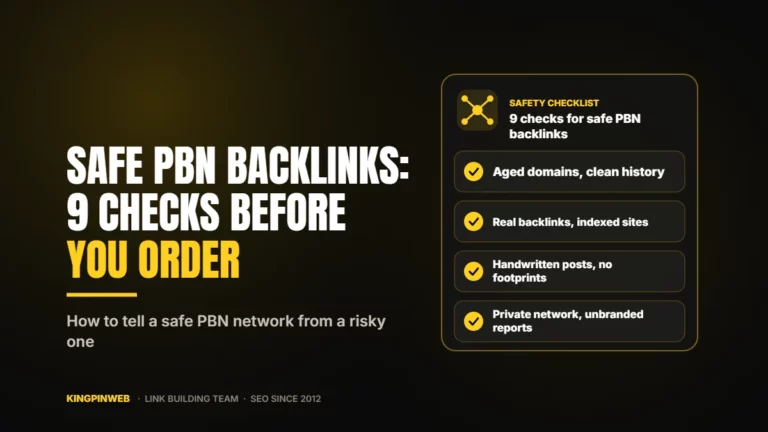 Safe PBN Backlinks: 9 Checks Before You OrderRead article
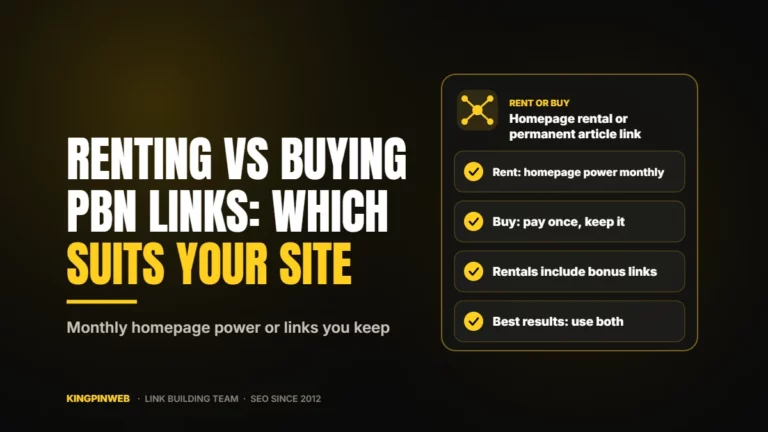 Renting vs Buying PBN Links: Which Suits Your SiteRead article
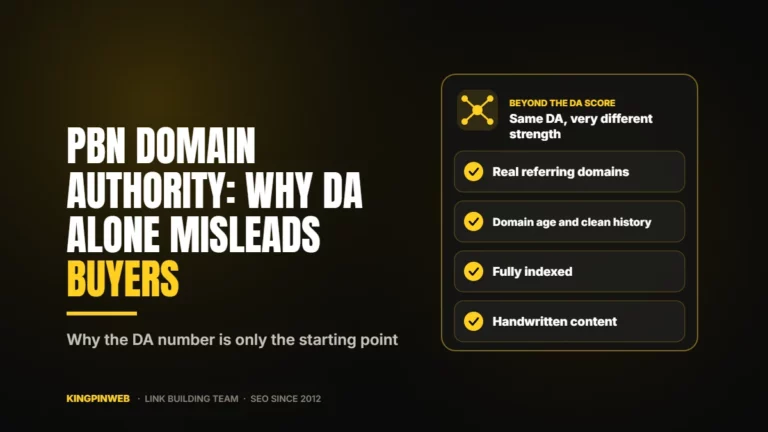 PBN Domain Authority: Why DA Alone Misleads BuyersRead article
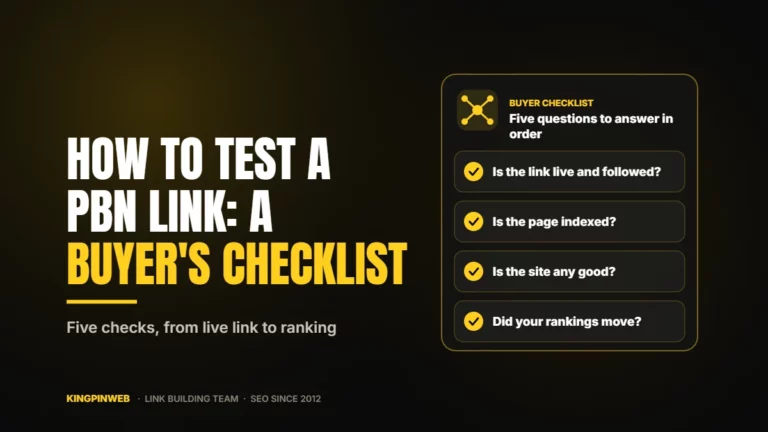 How to Test a PBN Link: A Buyer’s Checklist From Live to RankingRead article
 12 PBN Myths That Cost SEOs Rankings (And What Is Actually True)Read article
 PBN Anchor Text: How to Choose Anchors for Your Link OrdersRead article
 Do PBN Links Still Work in 2026? Honest Answer + ProofRead article