Key takeaways
- Anchor text is the clickable text of a link. It tells search engines what the linked page is about, so it is one of the few things you fully control when you order PBN links.
- There is no universal safe ratio. Ahrefs studied 384,614 pages and found only a weak relationship between exact-match anchors and rankings. The pages already ranking for your keyword are a better guide than any fixed number.
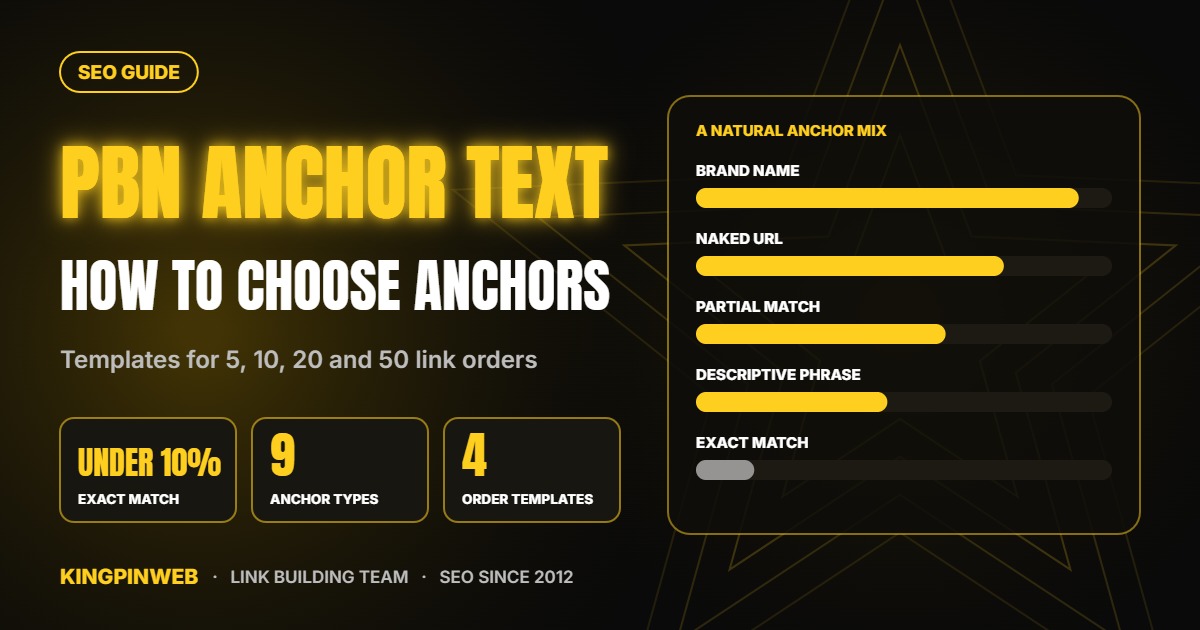
- Our working rule: keep exact-match anchors under 10% of the links to a page, often well under.
- A healthy mix uses brand names, plain URLs, partial matches and natural descriptive phrases.
- Use the templates below for 5, 10, 20 and 50 links as a starting point, then adjust to your page.
When you order PBN links you get to choose the anchor text and the page each link points to. That control is one of the main reasons SEOs like PBN links. This guide shows how to choose anchors that help your page rank and keep your link profile looking natural.
Why anchor text matters
Search engines read the anchor as a short description of the page behind the link. A link that says “emergency plumber in Austin” says more about the page than a link that says “click here”. Used in moderation, descriptive anchors help a page rank for the right terms.
The trouble starts when every link says the same thing. Real sites pick up links with all sorts of wording: the brand name, the address of the page, half a sentence, “this guide”. A page where most links use the exact keyword does not look like that, and links that look manufactured are the first to stop counting.
The types of anchor text
Examples for a made-up shop called Oakline that wants to rank a page for “standing desks”:
| Type | What it is | Example |
|---|---|---|
| Exact match | The keyword and nothing else | standing desks |
| Phrase match | The keyword inside a longer phrase | best standing desks for a home office |
| Partial match | Some of the keyword, or a close variation | desks you can stand at |
| Branded | The name of the business or site | Oakline |
| Brand + keyword | The brand and the keyword together | Oakline standing desks |
| Naked URL | The address of the page | yoursite.com/standing-desks |
| Generic | Words that say nothing about the topic | this page, see the full range |
| Descriptive | A natural phrase about the topic without the keyword | furniture that lets you work on your feet |
| Image | The alt text of a linked picture acts as the anchor | alt=”Oakline oak standing desk” |
Is there a safe anchor text ratio?
No, and anyone who quotes one fixed formula for every site is guessing.
The best public data comes from Ahrefs, which studied 384,614 pages across 19,840 keywords. It found only a weak relationship between the share of exact-match anchors and rankings, and most of the pages it looked at had no exact-match links at all. More exact-match anchors did not mean higher rankings.
What we see across client campaigns matches that:
- A few well-chosen keyword anchors help. Past that point, more of them add risk, not rankings.
- The right mix depends on the keyword. Some search results are full of pages with keyword-heavy profiles. Others are almost all brand names.
- Homepages naturally collect brand and URL anchors. Inner pages can carry a few more descriptive ones.
So we use a simple rule and a simple check. The rule: exact match under 10% of the links to a page, and often much lower. The check: look at what is already ranking.
How to check the anchors of pages that already rank
- Search your keyword and note the top five results. Skip directories and giant brands that rank for everything.
- Open each page, not the whole domain, in a backlink tool such as Ahrefs or Semrush and look at its anchors report.
- Sort the anchors into the types above and work out a rough share for each.
- Note the highest and lowest exact-match share. Your target is around the middle, never above the highest.
- Now do the same for your own page. If it is already heavy on keyword anchors, your next order should have none.
One caution: many private networks block these tools, so the profiles you see are incomplete. Treat the numbers as a guide, not as a recipe.
Anchor templates for 5, 10, 20 and 50 PBN links
These are starting points for links to one site, not rules. Adjust them to what you found in the check above.
| Order size | Suggested mix | Notes |
|---|---|---|
| 5 links | 1 partial match, 1 brand + keyword, 1 brand, 1 naked URL, 1 descriptive phrase | No exact match, unless the page has none yet |
| 10 links | 1 exact match, 3 partial or long-tail, 2 brand or brand + keyword, 2 naked URL, 2 descriptive or generic | Point two or three links at supporting pages |
| 20 links | 1 or 2 exact match, 5 or 6 partial or long-tail, 4 brand or brand + keyword, 4 naked URL, 4 descriptive or generic | Split across two or three target pages |
| 50 links | 3 or 4 exact match (different wording or different pages), 12 to 15 partial or long-tail, 10 brand, 10 naked URL, 10 descriptive or generic | Spread over several pages and several weeks |
Choose the right pages to point at
- Pick pages that are close. A page sitting between position 5 and 30 for its keyword has the most to gain from a few strong links.
- Fix the page first. Links push a relevant, well-written page. They do not make a thin page relevant.
- Do not send everything to one URL. Share links between the main page, the homepage and one or two supporting articles.
- Match the anchor to the page. The anchor should describe the page it points at. A keyword anchor pointing at an unrelated page helps nobody.
- Let the homepage take the brand. Brand names and plain URLs fit the homepage. Keep the more descriptive anchors for inner pages.
PBN links, guest posts and niche edits: how the anchors differ
| Link type | How much control you have | Anchors that work best |
|---|---|---|
| PBN links | Full control over anchor, target page and timing | A planned mix: mostly brand, URL and partial match, with a few carefully chosen keyword anchors |
| Guest posts | You suggest, the publisher decides | Brand or partial match that reads naturally in the article |
| Niche edits | The link is added to an existing paragraph | A descriptive or partial phrase that fits the sentence already there |
Because PBN links give you the most control, they are the easiest to overdo. Use that control to fill the gaps in your profile.
Anchor text for local SEO
Local pages rank with fewer links, so each anchor counts for more. A sensible mix for a local business:
- The business name: “Smith & Sons Plumbing”
- The name with the city: “Smith & Sons Plumbing in Austin”
- A natural service phrase: “a plumber in Austin who works weekends”
- The plain URL
- One exact service keyword at most: “emergency plumber Austin”
Write location anchors the way a person would say them. “Plumber in Austin” reads naturally. “Plumber Austin TX cheap” does not.
The words around the link
The anchor should sit in a sentence that makes sense, inside a paragraph about the same subject. That is one reason we write every PBN article by hand and place links on niche-relevant sites.
You do not need to stuff keywords around the link, though. A second Ahrefs study in the same guide looked at the words next to links on 16,000 pages and found almost no connection with rankings. Natural, relevant writing is enough.
A bad order and a good order
Ten links for a plumber targeting “emergency plumber Austin”:
| Bad order | Good order |
|---|---|
| emergency plumber Austin | Smith & Sons Plumbing |
| emergency plumber Austin | yoursite.com |
| emergency plumber Austin | emergency plumber Austin |
| emergency plumber Austin | a 24 hour plumber in Austin |
| emergency plumber Austin TX | Smith & Sons emergency call-outs |
| emergency plumber Austin TX | burst pipe repair in Austin |
| best emergency plumber Austin | this Austin plumbing company |
| best emergency plumber Austin | yoursite.com/emergency |
| cheap emergency plumber Austin | plumbers who answer the phone at night |
| emergency plumber Austin | Smith & Sons Plumbing in Austin |
The good order still tells search engines what the page is about. It just does it the way real links do.
How to fix an over-optimised anchor profile
- Stop adding keyword anchors. Your next orders should be brand, URL and descriptive only.
- Dilute. New brand and URL links bring the keyword share down over time.
- Change what you control. On links where the seller can edit the post, ask for a different anchor.
- Remove the worst. If one cheap batch of links caused the problem, have them taken down where you can.
- Give it time. Profiles are judged on the whole picture, and that picture changes with every new link.
Filling in the anchors on your order
For each link you give us one anchor and one target URL. Plan the full list before you order, using the template for your order size, and ask one question: would the list look normal to a stranger? If you are not sure, message us before you order and we will help you plan the mix.
FAQ
What is the best anchor text ratio for PBN links?
There is no single best ratio. Keep exact match under 10% of the links to a page and compare your mix with the pages that already rank for your keyword.
How much exact-match anchor text is safe?
Many SEOs stay between 1% and 5%. We advise staying under 10%, and lower when the pages ranking above you use very few.
Should PBN anchors be exact match?
A few can be. Most should be brand names, URLs, partial matches and descriptive phrases.
Does anchor text still matter?
Yes. It still tells search engines what a page is about. It matters most in moderation: a few descriptive anchors help, and a wall of them does not.
What anchors should I use for my homepage?
Mostly your brand name and plain URL, with the occasional brand + keyword anchor.
What anchor text works for local SEO?
The business name, the name with the city, natural service phrases and the plain URL. Use one exact service keyword at most.
Order PBN links
- POWERFUL PBN Links That Work: our most popular PBN service
- The Strongest PBN Links on the Planet: highest-authority domains for tough keywords
- Monthly Rental Sticky Homepage PBN Links: homepage placements
Want a mix? We also offer guest posts and niche edits. Questions before you order? Message us and we’ll help you plan the right mix for your site.
About the author

KINGPINWEB Team
KINGPINWEB is an SEO and link building company based in Chennai, India. Since 2012 our in-house team has helped site owners, agencies and businesses rank higher in search. Everything we publish here comes from hands-on work: campaigns we run, rankings we track every day and tests we carry out ourselves. We write these guides to share what works in practice.
Related reading
 How to Test a PBN Link: A Buyer’s Checklist From Live to RankingRead article
  13 PBN Myths That Cost SEOs Rankings (And What Is Actually True)Read article
 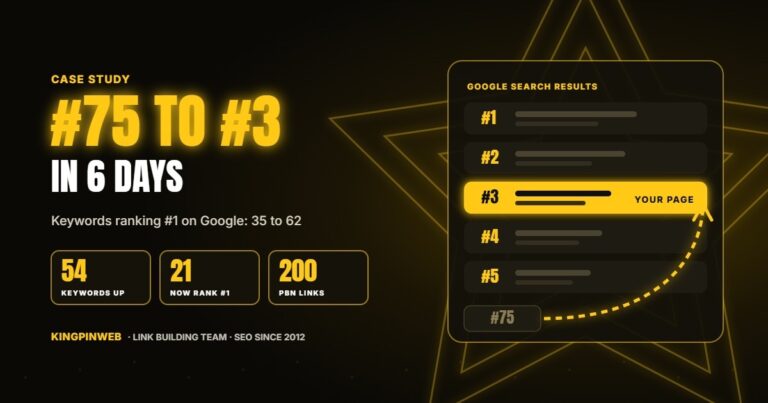 PBN Links Case Study (Sep 2026): #75 to #3 in 6 DaysRead article
 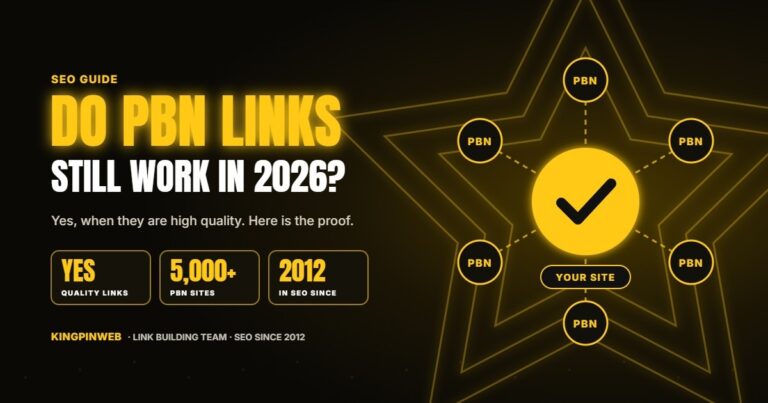 Do PBN Links Still Work in 2026? Honest Answer + ProofRead article
 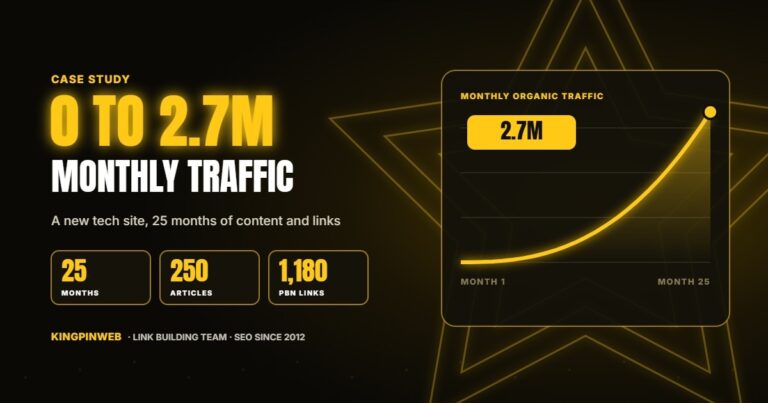 Zero to 2.7M Monthly Traffic in 25 Months (Case Study)Read article
 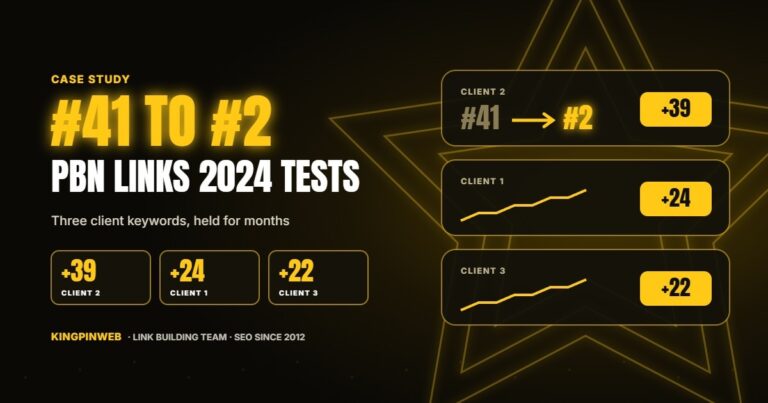 PBN Links 2024 Tests: #41 to #2 (Case Study)Read article
  Why SEOs Still Choose PBN LinksRead article
  Zero to 4.39M Monthly Traffic: SEO Case StudyRead article
  Expired Domains for SEO: The 2026 GuideRead article